Moving day is the single most intense day of your entire relocation. Weeks of planning, packing, and preparation converge into one high-stakes window where everything must flow smoothly. This moving day guide transforms that pressure into a calm, controlled operation by giving you an exact plan for every hour.
Metropolitan Movers Ottawa has executed thousands of moving days over 15+ years. We know exactly what separates a flawless move from a chaotic one — and it always comes down to preparation, timing, and communication. Every strategy in this guide comes directly from our professional crews’ daily playbook.
Check the moving rules and regulation
Whether you are moving across Ottawa or relocating across the country, your moving day plan determines whether you arrive at your new home feeling accomplished or overwhelmed. This resource gives you a complete moving day checklist, an hour-by-hour moving day timeline, professional moving truck loading techniques, essential safety protocols, and critical moving day tips that keep everything on track from dawn to dusk.
The Night Before: Final Moving Day Preparation
The outcome of your moving day is decided the night before. A rushed, unprepared morning leads to a chaotic day. A calm, organized evening sets up everything for success.
Night-Before Checklist
- Confirm arrival time and address with your movers via phone or text
- Charge your phone and portable power bank to 100%
- Set two alarms — 90 minutes before movers arrive
- Pack your moving day essentials box (detailed below) and place it by the front door
- Place valuables, important documents, and medications in your personal vehicle
- Confirm parking arrangements for the moving truck at both addresses
- Lay out comfortable clothing and closed-toe shoes for tomorrow
- Disassemble any remaining furniture and bag all hardware
- Ensure all boxes are sealed, labelled, and staged near the exit
- Do a walkthrough of every room — identify any items that still need packing
- Set the thermostat to a comfortable temperature (movers work hard — a hot house slows them down)
- Eat a proper dinner and get to bed early
The golden rule of moving day preparation: If it is not packed, labelled, and staged by the time you go to sleep, it will cause problems tomorrow.
For a comprehensive planning framework leading up to this day, explore our complete moving guide covering every phase from 8 weeks out through your first week at the new home.
Your Hour-by-Hour Moving Day Timeline
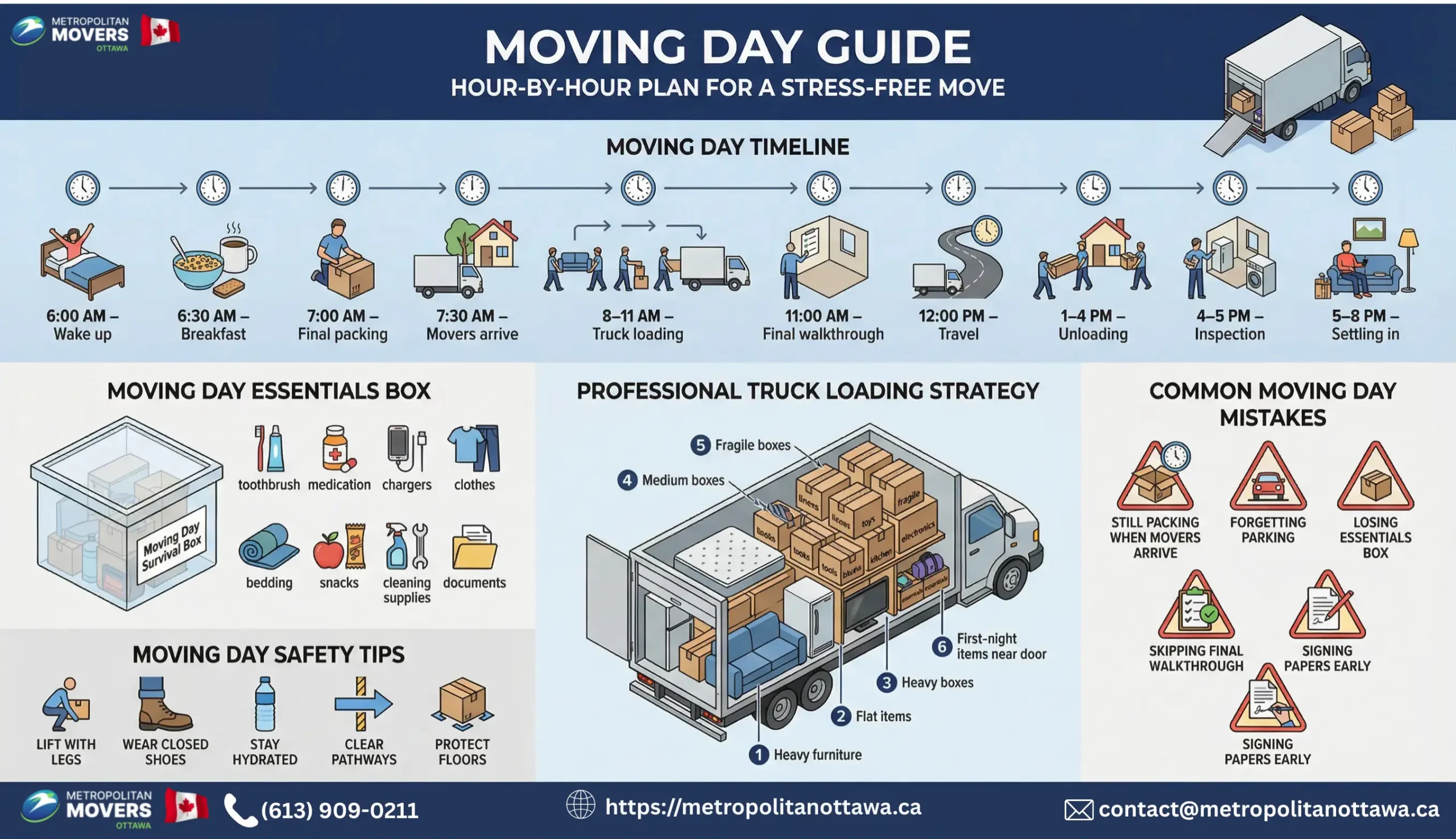
This moving day timeline gives you a structured schedule from wake-up through the end of your day. Adapt the exact times to your mover arrival time, but maintain the sequence and spacing.
Pro tip: Print this moving day timeline and tape it to the inside of your front door the night before. Reference it throughout the day to stay on schedule.
Morning Routine: The First 90 Minutes
The first 90 minutes of moving day set the tone for the entire operation. A rushed, chaotic start cascades into delays all day. A calm, deliberate start creates momentum.
Step 1: Wake Up Early (90 Minutes Before Movers)
Set two alarms. You need time to shower, eat, dress, and complete final tasks without rushing. Moving day is physically demanding — start fuelled and focused.
Step 2: Eat a High-Protein Breakfast
Skip the coffee-only approach. Your body needs sustained energy for 10–14 hours of physical and mental effort. Eggs, oatmeal, toast, fruit, and protein are your best options. Prepare a cooler with snacks and water for the day.
Step 3: Dress for the Job
- Closed-toe shoes with good grip (no sandals, no flip-flops)
- Comfortable, weather-appropriate layers
- Avoid loose jewellery that catches on furniture
- Tie back long hair
Step 4: Complete Final Packing Tasks
- Strip beds and pack sheets into a labelled bag
- Pack remaining toiletries (leave one hand towel accessible)
- Seal the final bathroom box
- Do one more walkthrough to catch stray items
Step 5: Stage Your Priority Items
Move these to your personal vehicle before the movers arrive:
- Moving day essentials box
- Valuables and jewellery
- Important documents (passports, IDs, lease/deed, insurance papers)
- Medications
- Laptop and chargers
- Children’s comfort bags
- Pet supplies and carrier
These items never go on the truck. They travel with you.
When the Movers Arrive
The first 15 minutes after your movers arrive determine the efficiency of the entire loading process. Use this time to communicate clearly and set expectations.
The Mover Walkthrough (First 15 Minutes)
- Greet the crew and introduce yourself — A professional, friendly start builds rapport and cooperation
- Walk them through every room — Point out fragile items, oversized furniture, items that require disassembly, and anything with special handling needs
- Identify items that DO NOT go on the truck — Essentials box, valuables, personal bags, items in your vehicle
- Share the floor plan of your new home — A simple printed or drawn layout showing which room gets which boxes and furniture pieces eliminates confusion at the destination
- Confirm the destination address — Ensure the driver has the exact address, your phone number, and building access details
- Discuss the loading sequence — Professional crews have their own system, but confirming priority items (mattresses last on = first off) is helpful
- Point out access challenges — Narrow doorways, steep stairs, low ceilings, tight corners, or restricted parking areas
Your Role During Loading
Your job during loading is simple but critical:
- Stay accessible — Be available to answer questions instantly. Do not leave the property during loading.
- Stay out of the way — Professional movers work in coordinated patterns. Standing in doorways or hallways slows them down.
- Monitor fragile items — Watch how your most valuable items are wrapped and loaded. Speak up immediately if you see something concerning.
- Keep the path clear — Remove obstacles, hold doors, and keep children and pets away from the work zone.
- Provide water and snacks — Hydrated, well-fed crews work faster and more carefully. This is not required, but it is appreciated and smart.
If you are looking for experienced, professional crews, Metropolitan Movers Ottawa provides trained, uniformed teams who follow standardized loading and protection protocols on every job.
Moving Truck Loading: The Professional Strategy
How a truck is loaded determines whether your belongings arrive safely or damaged. Professional moving truck loading follows a specific science of weight distribution, stacking, and securing.
The Loading Sequence
Weight Distribution Principles
- Distribute weight evenly across the truck floor — heavy concentration on one side causes dangerous truck handling
- Keep the centre of gravity low — Heavy items on the floor, light items on top. Never place heavy boxes on top of lighter ones
- Build walls from floor to ceiling — Create solid, vertical walls of boxes and furniture working from the cab end toward the door. Fill every gap to prevent shifting
- Secure the load — Use ratchet straps or rope at regular intervals to lock stacked walls in place
- Protect with blankets — Furniture blankets between every piece of furniture prevent scratches, dents, and finish damage
For expert container loading strategies, explore our guide on how to pack a moving container with professional space-maximizing techniques.
Moving Day Essentials Box: Your Survival Kit
Your moving day essentials box is the single most important container you pack. It holds everything you need for the first 24–48 hours when your other boxes are still sealed or in transit.
Pack this box the night before. Load it into your personal vehicle. Bring it inside first at your new home.
This box is your lifeline. When everything else is sealed or still on the truck, this one container keeps your household functioning through the first night.
Final Walkthrough and Departure Checklist
Before locking the door for the last time, walk through your old home systematically. The final walkthrough catches forgotten items and protects your security deposit.
Room-by-Room Walkthrough
Check every single one of these locations:
- Every bedroom closet (top shelf and floor)
- All bathroom cabinets and medicine cabinets
- Kitchen pantry, cabinets under the sink, and above the refrigerator
- Inside the dishwasher, oven, and microwave
- Laundry room shelves and behind the washer/dryer
- Basement and storage room corners
- Attic or crawl space
- Garage shelves, workbench drawers, and wall-mounted storage
- Outdoor shed, deck storage, and garden areas
- Mailbox
Departure Checklist
- All windows closed and locked
- All lights and fans turned off
- All faucets tightly closed
- Thermostat set to appropriate vacancy level
- HVAC filter clean (courtesy for next occupant or inspection)
- All interior and exterior doors locked
- Garage door closed and secured
- Keys placed as arranged (landlord, agent, lockbox, or counter)
- Mailbox emptied and forwarding active (Canada Post)
- Dated photographs taken of every empty room and all surfaces
These photographs are your insurance. If a landlord tries to withhold your security deposit for pre-existing damage or normal wear, dated photos of your clean, empty home are your strongest evidence.
Travelling to Your New Home
For local moves within the Ottawa area, travel time is minimal. For long-distance moves, you may travel separately from the truck and arrive hours or days apart.
Local Move Travel Tips
- Drive your personal vehicle to the new home ahead of or simultaneously with the truck
- Park in a location that does not block truck access to the driveway or loading zone
- Arrive early enough to do a quick walkthrough before the movers begin unloading
- Confirm all utilities are active (water, electricity, gas, internet)
Long-Distance Move Travel Tips
- Book overnight accommodation in advance if driving more than 8 hours
- Pack a separate travel bag with 1–2 days of clothing, toiletries, and medication
- Carry important documents and valuables in your vehicle at all times
- Keep your phone charged — the driver will call with delivery timing updates
- Plan arrival at the new home 1–2 hours before the truck’s estimated arrival window
For route-specific travel planning, explore our detailed corridor guides: Toronto to Ottawa, Toronto to Montreal, Toronto to Vancouver, or Toronto to Calgary.
Arrival: Directing the Unload
When the truck arrives at your new home, the efficiency of the unload depends almost entirely on your direction. Clear communication saves hours.
Before Unloading Begins
- Walk through the new home — Confirm it is clean, empty, and all utilities are working
- Place room labels on every door — Use printed signs or sticky notes with the room name (matching your box labels) on each doorframe
- Lay floor protection — Place cardboard runners or old sheets on high-traffic paths between the door and main rooms
- Identify furniture placement — Know exactly where the sofa, dining table, and beds go before the movers ask
During Unloading
- Stand at the truck or entry point and direct traffic — “Kitchen boxes go left, bedroom boxes upstairs, living room furniture straight ahead”
- Check items off your inventory list as they enter the home
- Inspect large furniture immediately for any transit damage — note issues on the bill of lading before signing
- Do not start unpacking boxes while movers are still unloading. You need to remain available for direction and inspection.
After Unloading
- Verify every item against your inventory list
- Note any damage on the delivery paperwork before signing
- Sign the bill of lading only after you are satisfied with the delivery
- Tip the crew if the service was excellent (standard: $20–$50 per mover for local; 10–15% for long-distance)
Moving Day Safety: Protecting People and Property
Moving day safety is critically important and almost universally overlooked. Moving is one of the leading causes of household injuries — heavy lifting, awkward stairways, sharp objects, and fatigue create a dangerous combination.
Personal Safety Rules
- Lift with your legs, not your back — Bend at the knees, keep the load close to your body, and push up through your legs
- Never carry more than you can comfortably handle — Make two trips instead of risking injury
- Wear closed-toe shoes with non-slip soles at all times
- Stay hydrated — Drink water every 30 minutes, especially in warm weather
- Take breaks — 10 minutes of rest every 90 minutes prevents fatigue-related injuries
- Never carry items while walking backward on stairs or ramps
- Keep pathways clear — Remove rugs, toys, shoes, and obstacles from all walking routes
Property Protection
- Lay floor runners on hardwood, tile, and laminate flooring in high-traffic areas
- Apply corner protectors to all door frames and wall corners on the moving route
- Remove doors that create narrow passages for large furniture (takes 2 minutes per door)
- Protect banisters by wrapping stairway railings in moving blankets
- Cover landscaping near the truck with plywood to prevent lawn damage from heavy foot traffic
Weather Preparedness
Metropolitan Movers Ottawa crews are trained for all-season moving. Whether your move falls in July heat or a January snowstorm, our teams carry the equipment and experience to protect your belongings and everyone involved.
Moving Day With Kids, Pets, and Seniors
Moving day is stressful for adults. For children, pets, and elderly family members, it can be overwhelming and even dangerous. Here is how to keep everyone safe and comfortable.
Kids on Moving Day
- Arrange childcare if at all possible. A friend, family member, or babysitter keeps kids safe and lets you focus.
- If kids must be present, designate one adult exclusively to supervise them — not you, because you need to direct movers.
- Pack a kid-specific bag with favourite toys, books, snacks, tablet, and headphones.
- Keep children away from the truck, ramp, and loading zones at all times.
- Set up their bedroom first at the new home so they have a familiar, comfortable space immediately.
Pets on Moving Day
- Confine pets to one empty room with their bed, water, food, and a familiar toy. Place a sign on the closed door: “PET INSIDE — DO NOT OPEN.”
- Transport pets in your personal vehicle — never in the moving truck.
- Keep carriers, medication, vet records, and comfort items accessible in your vehicle.
- Set up a pet zone first at the new home with their bed, bowls, and familiar items before letting them explore.
- Update microchip and ID tag information with your new address within the first week.
Seniors on Moving Day
- Involve them in decisions but minimize their physical role — moving day is not the day for heavy lifting at any age.
- Keep medications, medical equipment, and mobility aids immediately accessible at all times.
- Ensure the new home is safe before arrival — handrails, non-slip surfaces, clear pathways.
- Set up their bedroom and bathroom first for immediate comfort and familiarity.
Our team specializes in moving services for senior citizens with gentle handling, patience, and dedicated crews trained for senior-specific needs.
Moving Day Organization Systems That Save Hours
Moving day organization is the invisible infrastructure that separates a smooth move from a chaotic one. These systems cost nothing to implement but save enormous time.
Colour-Coded Room Labels
Assign each room a colour. Place matching coloured tape or stickers on every box destined for that room. At the new home, place matching coloured signs on each door.
Numbered Inventory System
Assign every box a sequential number. Record that number and its contents on a master inventory sheet (paper or app). On delivery, check off each number. A missing number means a missing box — and you will know exactly what was inside it.
Priority Marking
Mark the boxes you need unpacked first with a bold “★ PRIORITY” on all sides. These get carried in last (so they come off first) or placed in a designated priority zone at the new home.
If you need expert help with packing and unpacking, our crews use professional-grade labelling systems that make moving day seamless.
Common Moving Day Mistakes That Cost You
These moving day mistakes are the most frequent errors we see after 15+ years of professional moving. Every one of them is preventable.
1. Not Being Fully Packed When Movers Arrive
This is the number one moving day mistake. If movers arrive and you are still packing, the clock is already running. Every minute they wait is a minute you pay for. Be 100% packed, sealed, labelled, and staged before the crew walks through your door.
2. Forgetting to Reserve Parking
A moving truck needs a clear loading zone within 75 feet of your front door at both locations. If the truck cannot park close, long-carry surcharges apply. In condo buildings, reserve the elevator and loading dock in advance.
3. Not Being Present or Accessible
You need to be physically present and available to answer questions throughout loading and unloading. Disappearing to run errands or hiding in another room creates confusion and delays.
4. Leaving the Essentials Box on the Truck
If your toiletries, medications, chargers, sheets, and first-night supplies ride on the truck instead of in your vehicle, you will spend your first night miserable. The essentials box always travels with you.
5. Skipping the Final Walkthrough
Every mover has a story about the homeowner who left behind items in the attic, the garden shed, or the dishwasher. Check every room, every cabinet, every closet, and every outdoor area before leaving.
6. Not Photographing the Old Home
Without dated photos of your clean, empty home, you have no defence if a landlord claims damage and withholds your security deposit. Photograph everything.
7. Signing Before Inspecting
Never sign the bill of lading or delivery paperwork until you have inspected every piece of furniture and verified your inventory. Once you sign, your leverage for damage claims drops significantly.
8. Not Planning Meals
Moving day burns 3,000–5,000 calories depending on your involvement level. Without pre-planned meals and snacks, you end up ordering expensive delivery or skipping meals entirely — both of which kill your energy and mood.
End-of-Day Priorities at Your New Home
The movers have left. The truck is gone. You are standing in a home full of boxes. Here is exactly what to do before you sleep tonight.
Priority 1: Set Up Beds (30 minutes)
You will be exhausted tonight. Having made beds with sheets, pillows, and blankets ready is non-negotiable. Set up one bed per person in your household before anything else.
Priority 2: Unpack the Essentials Box (15 minutes)
Place toiletries in the bathroom, plug in chargers, set out cleaning supplies, and position snacks and water in the kitchen area.
Priority 3: Confirm All Utilities (10 minutes)
- Test hot and cold water in multiple locations
- Confirm electricity in every room (flip switches)
- Verify gas appliances if applicable (stove, furnace, hot water tank)
- Check internet connection if pre-arranged
- Locate the circuit breaker panel, water shut-off valve, and furnace
Priority 4: Safety Check (10 minutes)
- Install fresh batteries in all smoke detectors and carbon monoxide alarms
- Confirm all exterior doors and windows lock properly
- Test the security system if applicable
- Locate the nearest fire extinguisher or make a note to purchase one immediately
Priority 5: Lock Up and Rest
Close all windows, lock all doors, set the thermostat, and get to bed. Tomorrow is unpacking day — not tonight.
For a detailed day-by-day unpacking strategy, follow our how to unpack after moving guide that transforms box chaos into organized rooms within a week.
If you recently moved to the Ottawa area, our first week after moving to Ottawa guide covers local registrations, neighbourhood discovery, and settling-in priorities specific to the region.
FAQ: Moving Day Guide
What time should I wake up on moving day?
Wake up at least 90 minutes before your movers are scheduled to arrive. This gives you time to shower, eat a full breakfast, complete final packing tasks, stage essentials in your vehicle, and be completely ready when the crew walks through the door.
How long does a local moving day take?
A typical local move for a 2-bedroom apartment takes 4–6 hours including loading, transit, and unloading. A 3–4 bedroom house takes 6–10 hours. Preparation level, access difficulty, and crew size all impact the total time.
What should I do while the movers are loading?
Stay present and accessible to answer questions. Monitor the loading of fragile items. Keep pathways clear. Do not try to help carry heavy furniture unless specifically asked — it can cause injuries and liability issues. Stay out of the direct loading path but remain visible and available.
Should I tip my movers?
Tipping is not mandatory but is appreciated for excellent service. Standard guidelines: $20–$50 per mover for local moves, or 10–15% of the total bill for long-distance moves.
What if it rains on moving day?
Most professional movers operate in all weather conditions. Cover items with plastic wrap or tarps during the walk between door and truck. Lay non-slip mats on ramps and entryways. Wrap moisture-sensitive electronics in extra plastic. Allow additional time for cautious movement.
What should I do if something is damaged during the move?
Document the damage immediately with photographs. Note the damage on the bill of lading or delivery paperwork before signing. File a written claim with your moving company within the timeframe specified in your contract (typically 30–90 days).
How do I keep pets safe on moving day?
Confine pets to one quiet room with their essentials and a closed door. Place a visible sign on the door. Transport them in your personal vehicle. Set up a familiar space at the new home immediately upon arrival.
What goes in the essentials box?
Toiletries, medications, phone chargers, change of clothes per person, bed sheets, towels, basic cleaning supplies, snacks, water, tools, important documents, and children’s or pet supplies.
How do I protect floors during the move?
Lay cardboard runners, old sheets, or purpose-built floor runners on all high-traffic paths. Use furniture pads under heavy items. Remove shoes when walking on newly cleaned floors at the new home.
Can I move everything in one trip?
For local moves with a properly sized truck, yes. Your movers will assess your inventory and recommend the right truck size. For very large homes, a second trip or a larger truck may be needed. Long-distance moves should always be completed in a single load.
Conclusion
Moving day does not need to be stressful when every hour has a plan. This moving day guide has given you the complete framework — a detailed moving day timeline, professional moving truck loading strategy, a comprehensive moving day checklist, critical moving day safety protocols, and proven moving day tips that our crews use on every job.
The moving day mistakes that derail most families are entirely preventable. Start the night before with thorough moving day preparation, wake up early, communicate clearly with your movers, and follow the hour-by-hour moving day plan outlined above. When you do, you will close the door on your old home with confidence and open the door to your new one feeling accomplished.
Your moving day organization directly determines how smoothly your first week goes. Every box placed in the right room, every piece of furniture positioned correctly, and every item verified against your inventory list makes unpacking faster and easier.
Metropolitan Movers Ottawa has delivered flawless moving days for 15+ years. Whether you need full-service residential moving in Ottawa, local moving in Orleans, house moving in Nepean, furniture moving in Kanata, office moving for businesses, or piano moving with specialized equipment, our trained, uniformed crews deliver professional execution on every job.
Explore all of our moving services or visit our service area pages for Ottawa, Kanata, Nepean, Orleans, or Gatineau. Need a last-minute moving team or storage between homes? We have you covered.
Ready for your stress-free moving day? Contact us today for a transparent, binding estimate from our relocation