
A comprehensive garage packing guide is essential because garages accumulate more volume and variety of items than any other single space in your home. From power tools and hand tools to garden equipment, sports gear, paint cans, automotive fluids, and seasonal decorations, your garage contains hundreds of items across dozens of categories — each requiring different packing strategies, safety protocols, and disposal considerations. Whether you are relocating within Ottawa, moving across Ontario, or managing a long-distance move across Canada, mastering this garage packing guide ensures your tools arrive organized and undamaged, hazardous materials are disposed of properly, and your garage unpacking does not become a week-long nightmare of searching through unmarked boxes for basic equipment.
This garage packing guide covers decluttering strategies, tool organization systems, hazardous materials identification and disposal, outdoor equipment protection, and timeline planning. By the time you finish reading, you will have a clear action plan for transforming your garage from overwhelming chaos into systematically packed, safely transported belongings.
For the complete moving preparation framework beyond just garage packing, the complete moving guide covers every phase of your relocation from planning through settling in. For detailed packing strategies across your entire home, explore the complete packing guide for moving. And for material sourcing and general packing principles, the packing supplies you need resource provides essential context.
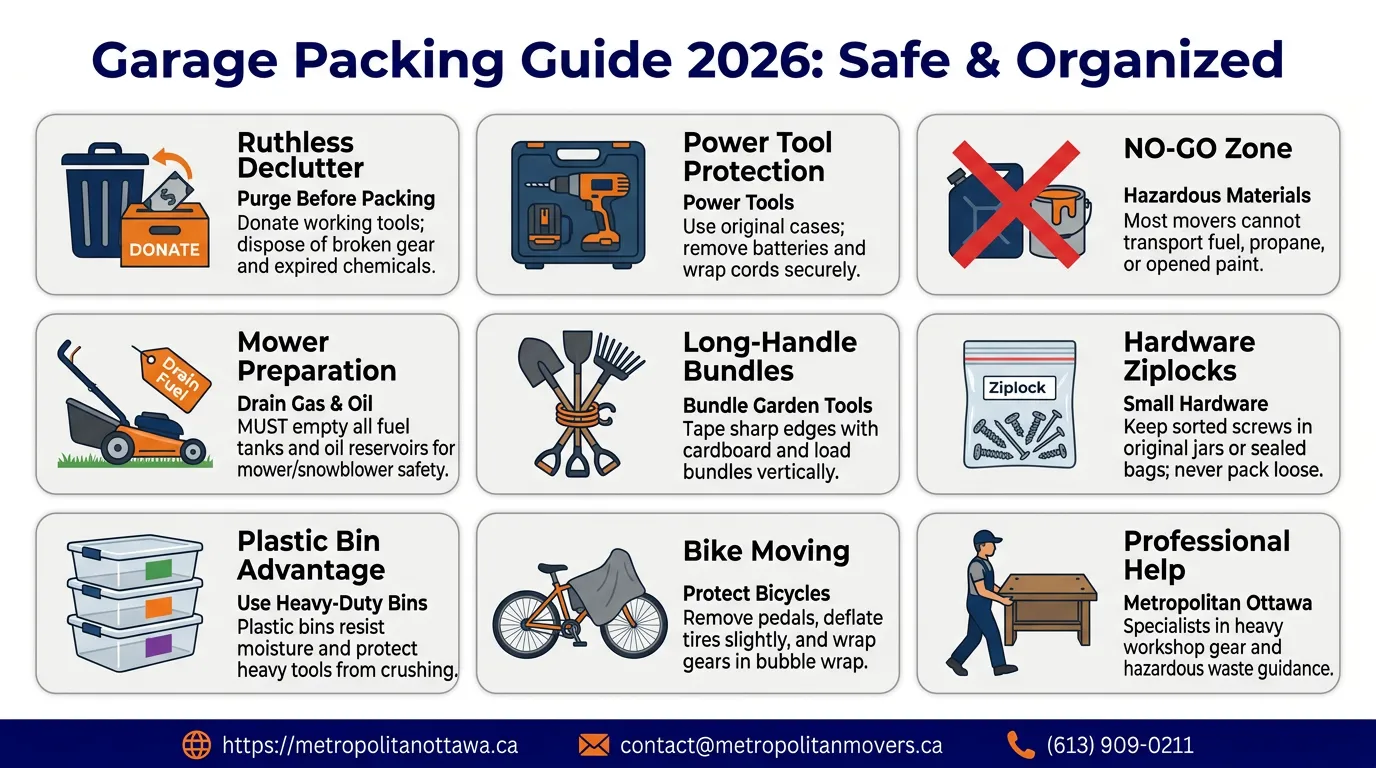
Why a Garage Packing Guide Requires Different Strategies Than Other Rooms
This garage packing guide addresses unique challenges no other room presents: heavy power tools that require secure packing, sharp garden tools that pose safety hazards, flammable liquids and chemicals that moving companies cannot transport, and massive volume accumulation that most homeowners drastically underestimate. Unlike living rooms or bedrooms where items fit predictable categories, garages contain everything from bicycles and lawn mowers to half-empty paint cans and boxes of screws sorted into baby food jars.
Most households approach garage packing as an afterthought, leaving it for the final day and discovering they have 3–4 truck loads worth of items with nowhere near enough boxes or time to pack properly. This creates three predictable disasters: tools thrown into garbage bags without organization, hazardous materials loaded onto moving trucks illegally, and essential items lost in unmarked boxes for months after moving.
Metropolitan Movers Ottawa has witnessed every garage packing failure imaginable: power tools damaged from inadequate cushioning, gasoline cans loaded onto trucks creating fire hazards, and entire garages worth of items dumped into moving trucks loose without any packing whatsoever. Following this proven garage packing guide prevents these outcomes and ensures your garage transitions smoothly to your new home.
Garage Packing Timeline: Start Earlier Than You Think
The garage packing guide timeline must begin weeks before moving day because decluttering, hazardous material disposal, and proper packing take significantly longer than most people estimate.
3–4 Weeks Before Moving Day: Declutter and Inventory
Start your garage packing guide timeline by conducting a complete garage inventory. Pull everything out into your driveway or yard on a clear day, sort into categories (tools, sports equipment, gardening, automotive, seasonal decorations), and make ruthless decluttering decisions. Donate, sell, or dispose of broken tools, expired chemicals, unused sporting goods, and items you have not touched in over a year.
2–3 Weeks Before Moving: Hazardous Materials Disposal
Identify and properly dispose of all hazardous materials that cannot be transported on moving trucks: paint (opened cans), gasoline, motor oil, pesticides, herbicides, propane tanks, cleaning chemicals, automotive fluids, and aerosol cans. Contact your municipal hazardous waste facility for drop-off schedules and requirements.
1 Week Before Moving: Pack Non-Essential Items
Pack seasonal items you will not need before moving day: winter equipment in summer, summer items in winter, seasonal decorations, extra sporting goods, and backup tools. This phase reduces garage clutter while leaving essential items accessible.
3–5 Days Before Moving: Pack Primary Garage Items
Pack the majority of your garage using the category-based system detailed below. Organize tools in clearly labeled boxes, wrap sharp implements safely, and create an inventory list of high-value items.
Moving Day: Final Items and Cleaning
Pack final items like brooms, shovels, and trash cans you used until the last moment. Sweep the garage clean and conduct a final walkthrough for items left on shelves or in corners.
The packing checklist for moving provides a room-by-room timeline for your entire home, and the moving day guide covers final-day logistics and coordination.
Decluttering Garage Before Moving: The Most Important Step in Any Garage Packing Guide
Decluttering your garage before moving is not optional — it is the foundation of successful garage packing. Garages accumulate items faster than any other space because they function as storage overflow, project workshops, and dumping grounds for items without designated homes.
Ask the Ruthless Decluttering Questions:
- Have I used this item in the past year?
- Does this item still work properly?
- Would it cost less to replace than to move?
- Do I have duplicates of this tool or item?
- Will this item fit in my new garage space?
Decluttering Categories for Garage Items:
Donate or Sell: Working tools you no longer use, sporting goods your children have outgrown, functional equipment that does not fit your new property (snow blower when moving to a condo, lawn mower when moving to an apartment).
Dispose Properly: Broken tools beyond repair, expired chemicals, rusted garden equipment, rotted wood scraps, empty paint cans.
Keep and Pack: Tools you use regularly, seasonal equipment that fits your new home, sporting goods in active use, automotive supplies for vehicles you own, quality items in good condition.
Reducing garage inventory by 30–50 percent through decluttering saves moving costs, reduces packing time, and prevents transferring junk to your new home.
Garage Packing Guide: Tools, Equipment & Hazardous Materials by Category
| Garage Item Category | Packing Method | Materials Needed | Special Notes |
|---|---|---|---|
| Power Tools | Use original cases; if unavailable, wrap in bubble wrap and pack in small boxes | Tool cases, bubble wrap, small boxes, ziplock bags for bits/accessories | Remove batteries; wrap cords securely; pack accessories with corresponding tool |
| Hand Tools | Keep in toolboxes or wrap sharp items separately; pack by category | Toolboxes, bubble wrap for sharp items, small boxes, labels | Wrap saw blades, chisels, utility knives in cardboard before packing |
| Garden Tools (Shovels, Rakes) | Bundle together with rope; wrap sharp edges in cardboard | Rope or bungee cords, cardboard, moving blankets | Clean dirt off before packing; secure bundle to prevent shifting |
| Lawn Mower | Drain fuel and oil; clean thoroughly; secure moving parts | Moving blankets, bungee cords, oil drain pan | MUST drain all fuel — no exceptions; remove spark plug for safety |
| Bicycles | Remove pedals and front wheel; wrap in blankets or use bike boxes | Allen keys, moving blankets, bike boxes (optional), bubble wrap | Deflate tires slightly; protect gears and derailleurs from damage |
| Paint & Chemicals | DISPOSE PROPERLY — most cannot be transported on moving trucks | N/A — disposal required | Unopened sealed paint MAY be transported — check with moving company first |
| Sports Equipment | Pack by sport/season in labeled boxes; deflate balls slightly | Medium/large boxes, bubble wrap for fragile items, labels | Golf clubs, skis, hockey sticks can bundle together with blankets |
| Seasonal Decorations | Pack in original boxes or plastic storage bins; label by holiday | Original boxes, plastic bins, bubble wrap for fragile ornaments | Wrap fragile ornaments individually; artificial trees disassemble by section |
| Garage packing guide by category — methods and materials for safe, organized packing. Always prioritize hazardous materials disposal and tool protection. | |||
Packing Garage Tools: Power Tools, Hand Tools, and Workshop Equipment
Packing garage tools properly within your garage packing guide ensures expensive equipment arrives undamaged and organized for immediate use in your new workshop.
Packing Power Tools
Power tools represent significant investment and require careful protection. Pack drills, saws, sanders, and routers in their original carrying cases whenever possible — these cases provide custom-fit protection designed specifically for each tool. If original cases are unavailable:
- Remove all batteries and pack them separately in ziplock bags
- Wrap power cords securely around the tool body and secure with twist ties
- Wrap the entire tool in bubble wrap, paying extra attention to exposed blades or bits
- Pack in small boxes with cushioning on all sides
- Pack all accessories (drill bits, saw blades, sanding discs) in labeled ziplock bags and pack with the corresponding tool
Packing Hand Tools
Hand tools can remain in toolboxes if the boxes are sturdy and latches secure properly. For loose hand tools:
- Sort by category (screwdrivers together, wrenches together, pliers together)
- Wrap sharp items (chisels, utility knives, hand saws) individually in cardboard sleeves before packing
- Pack heavy items like hammers and mallets in small boxes to keep weight manageable
- Label boxes clearly by tool category for easy unpacking
Small Hardware and Fasteners
Screws, nails, bolts, and small hardware pieces create organizational chaos if not handled systematically. Keep sorted hardware in original containers, secure lids with tape, and pack containers in small boxes labeled “GARAGE — HARDWARE.” Never dump loose hardware into boxes — you will never sort it again.
For comprehensive tool protection across all categories, the complete packing guide for moving covers workshop and hobby equipment in detail.
Hazardous Materials Disposal: What Cannot Go on the Moving Truck
Hazardous materials disposal is the most critical safety component of any garage packing guide. Moving companies are legally prohibited from transporting many common garage items due to fire, explosion, and environmental hazards.
Items That CANNOT Be Transported on Moving Trucks:
- Flammable Liquids: Gasoline, kerosene, lighter fluid, propane tanks, fuel additives
- Automotive Fluids: Motor oil (opened containers), brake fluid, transmission fluid, antifreeze
- Paint Products: Opened paint cans, paint thinner, paint stripper, varnish, lacquer
- Chemicals: Pesticides, herbicides, fertilizers (liquid), pool chemicals, acids, household cleaners (opened)
- Compressed Gases: Propane cylinders, helium tanks, oxygen tanks
- Batteries: Car batteries, rechargeable batteries (some exceptions for small device batteries)
- Ammunition: Firearms ammunition, black powder, fireworks
Proper Disposal Methods:
Contact your municipal hazardous waste facility or household hazardous waste collection program for disposal instructions. Most municipalities offer regular collection days or permanent drop-off facilities. Never dump chemicals down drains, pour onto the ground, or throw in regular garbage — these actions contaminate water supplies and violate environmental regulations.
What CAN Be Transported (With Restrictions):
- Unopened, factory-sealed paint cans (check with your moving company first)
- Unopened automotive fluids in original sealed containers (quantity limits may apply)
- Unopened cleaning supplies in original sealed containers
- Small device batteries still in packages
Always disclose all chemicals and potentially hazardous materials to your moving company during the estimate process. Undisclosed hazardous materials create legal liability and safety risks for everyone involved.
For households using professional moving services, Metropolitan Movers Ottawa provides residential moving in Ottawa services that include hazardous materials consultation and disposal guidance.
Moving Garden Tools and Outdoor Equipment
Moving garden tools and outdoor equipment requires specific preparation to prevent damage and ensure everything functions at your new property.
Preparing the Lawn Mower
Lawn mowers MUST be completely drained of fuel and oil before loading on moving trucks — this is non-negotiable for safety and legal compliance:
- Run the mower until the fuel tank is empty
- Drain the oil completely into an appropriate container
- Clean the mower deck thoroughly to remove grass clippings and dirt
- Remove or secure the spark plug
- Wrap the mower in moving blankets and secure with bungee cords
Garden Hand Tools
Shovels, rakes, hoes, and hand cultivators should be cleaned of dirt before packing. Bundle long-handled tools together with rope or bungee cords, wrap sharp edges (shovel blades, hoe blades) in cardboard, and load vertically in the truck rather than laying flat where they create trip hazards.
Power Garden Equipment
String trimmers, hedge trimmers, leaf blowers, and chainsaws all require fuel drainage before moving. Remove fuel from all tanks, run equipment until it stops, drain oil reservoirs, and pack in original cases or wrap in moving blankets.
Hoses and Sprinklers
Drain garden hoses completely, coil neatly, and secure with rope or hose hangers. Pack sprinklers, spray nozzles, and watering accessories in a labeled box.
Garage Storage Bins and Organizational Systems
Garage storage bins provide the most efficient packing and unpacking system for garage items because they are durable, stackable, and reusable at your new home.
Advantages of Plastic Storage Bins Over Cardboard Boxes:
- Weather Resistance: Plastic bins protect contents from moisture during outdoor staging and truck loading
- Durability: Bins do not crush under weight like cardboard boxes
- Reusability: Bins become permanent garage storage at your new home
- Visibility: Clear bins allow you to see contents without opening
- Stackability: Uniform bin sizes stack securely in moving trucks and storage
Organizational System for Garage Bins:
Use color-coded lids or labels to identify categories:
- Red Bins: Tools and hardware
- Blue Bins: Automotive supplies and equipment
- Green Bins: Gardening and outdoor equipment
- Yellow Bins: Sports equipment and recreational items
- Clear Bins: Seasonal decorations
Label each bin clearly with contents and destination (“GARAGE — POWER TOOLS” or “GARAGE — WINTER SPORTS EQUIPMENT”).
The packing supplies you need guide covers storage bin sourcing and sizing recommendations.
Organizing Garage Items by Category for Efficient Packing and Unpacking
Organizing garage items by category within your garage packing guide creates systematic packing and dramatically faster unpacking at your new home.
Category-Based Packing Strategy:
Rather than packing items by shelf or location, pack by use category regardless of where items currently sit:
Automotive Category: Car care supplies, motor oil (sealed), windshield washer fluid, tire pressure gauge, jumper cables, car wash supplies
Gardening Category: Hand tools, gloves, seeds, plant food (dry), pots, watering accessories, garden decorations
Workshop Category: Power tools, hand tools, hardware, measuring tools, safety equipment
Sports & Recreation Category: Bikes, sports equipment, camping gear, outdoor games, exercise equipment
Seasonal Category: Holiday decorations, winter equipment (snow shovels, ice melt), summer equipment (pool accessories, beach gear)
Maintenance Category: Cleaning supplies, light bulbs, extension cords, batteries, household repair items
This category-based approach means when you need your drill at the new house, you know exactly which box to open rather than searching through dozens of randomly packed containers.
Packing Outdoor Equipment: Grills, Patio Furniture, and Seasonal Items
Packing outdoor equipment as part of your garage packing guide requires cleaning, disassembly, and protection from the elements.
Barbecue Grills
Clean your grill thoroughly before moving — caked-on grease and food residue attract pests and create odors during transit. Disconnect and properly dispose of propane tanks (cannot be transported on moving trucks). Remove grill grates and wrap separately. Wrap the grill body in moving blankets and secure with bungee cords.
Patio Furniture
Clean all patio furniture before packing. Stack chairs if design allows, wrap glass table tops separately in bubble wrap and cardboard, and protect metal or wooden furniture with moving blankets to prevent scratching.
Snow Blowers and Winter Equipment
Drain all fuel from snow blowers, clean thoroughly, and wrap in moving blankets. Pack snow shovels, ice scrapers, and ice melt (sealed containers only) together in labeled boxes.
Pool Equipment
Drain and dry pool accessories completely. Pack pool chemicals separately from other items (or dispose of opened chemicals properly). Collapse portable pools and pack in original bags or large boxes.
Garage Moving Supplies: What Materials You Need Beyond Basic Boxes
This garage packing guide requires specialized materials beyond standard moving boxes because garage items are heavier, larger, and more awkwardly shaped than typical household belongings.
Essential Garage Moving Supplies:
- Plastic storage bins in multiple sizes for category-based packing
- Heavy-duty boxes rated for 65+ pounds for tools and hardware
- Moving blankets for furniture, tools, and equipment protection
- Bubble wrap for power tools and fragile items
- Rope and bungee cords for bundling long-handled tools and securing equipment
- Ziplock bags in multiple sizes for hardware, small parts, and accessories
- Cardboard sleeves for wrapping sharp tools and blades
- Labels and permanent markers for clear identification
- Packing tape — heavy-duty tape rated for heavier loads
For comprehensive material sourcing across your entire move, the packing supplies you need guide provides shopping lists and sourcing recommendations.
When Professional Garage Packing Makes Sense
For households with extensive tool collections, large workshops, multiple vehicles worth of automotive supplies, or limited time, professional packing services eliminate stress and ensure proper hazardous materials identification. Metropolitan Movers Ottawa provides full-service garage packing using professional-grade materials, proven organization systems, and efficient timelines that complete in hours what would take days for DIY packers.
Professional packing also includes hazardous materials consultation — experienced packers identify items that cannot be transported and provide disposal guidance. DIY packers often unknowingly load prohibited items on trucks, creating legal liability and safety risks.
For families managing entire household relocations, the house moving service covers full-home logistics from packing through final placement. For those relocating to Ottawa from other Canadian cities, Metropolitan Movers Ottawa manages long-distance garage relocations as part of comprehensive cross-province moves. Relevant routes include moving from Toronto to Ottawa, Toronto to Montreal, and Toronto to Vancouver.
The how to unpack after moving guide covers efficient unpacking sequencing once you arrive at your new home.
FAQs: Garage Packing Guide
How far in advance should I start packing my garage?
Start your garage packing guide timeline 3–4 weeks before moving day. Week one focuses on decluttering and inventory, weeks two and three handle hazardous materials disposal and non-essential packing, and the final week addresses primary garage packing. Garages contain more volume than most people estimate and take significantly longer to pack than other rooms.
What garage items cannot be transported on moving trucks?
Moving companies cannot legally transport gasoline, propane tanks, opened paint cans, pesticides, herbicides, pool chemicals, automotive fluids (opened containers), ammunition, and most compressed gases. These items create fire, explosion, and environmental hazards. Contact your municipal hazardous waste facility for proper disposal. The complete moving guide covers hazardous materials identification in detail.
Do I need to drain my lawn mower before moving?
Yes — absolutely required. Drain all fuel and oil from lawn mowers, snow blowers, string trimmers, and any gas-powered equipment before loading on moving trucks. Run equipment until fuel tanks are empty, drain oil into appropriate containers, and clean equipment thoroughly. Undrained fuel creates fire hazards and violates moving company policies and transportation regulations.
Should I pack garage items in boxes or plastic bins?
Plastic storage bins are superior for garage packing because they resist moisture, stack securely, do not crush under weight, and become permanent storage at your new home. Use bins for tools, hardware, automotive supplies, and outdoor equipment. Reserve cardboard boxes for seasonal decorations and lightweight items. Color-code bins by category for efficient unpacking.
How do I pack power tools without damaging them?
Pack power tools in original carrying cases whenever possible. If cases are unavailable, remove batteries, wrap cords securely, wrap the entire tool in bubble wrap, and pack in small boxes with cushioning. Pack all accessories (bits, blades, discs) in labeled ziplock bags with the corresponding tool. Never pack loose power tools directly in trucks where they will shift and collide.
What should I do with paint and chemicals before moving?
Dispose of opened paint cans, paint thinner, pesticides, herbicides, and cleaning chemicals through your municipal hazardous waste program. Unopened, factory-sealed paint MAY be transported — check with your moving company first as policies vary. Never load opened chemicals on moving trucks without explicit permission from your moving company.
How do I organize garage items for efficient unpacking?
Pack by use category rather than by location. Create automotive, gardening, workshop, sports, seasonal, and maintenance categories. Label all boxes and bins clearly with contents and destination. Keep related items together (pack drill bits with drills, garden gloves with garden tools). This category-based system means you can find specific items immediately rather than searching through dozens of random boxes.
Does Metropolitan Movers Ottawa provide garage packing services?
Yes. Metropolitan Movers Ottawa offers both full-service packing for entire homes and room-specific packing services for households that want professional handling of garages while managing other rooms themselves. Professional garage packing includes hazardous materials consultation, tool organization, equipment protection, and disposal guidance. The packing and unpacking service page provides full service details.
Garage Packing Guide: From Overwhelming Chaos to Organized System
This garage packing guide transforms the most volume-heavy and organizationally challenging space in your home from an overwhelming packing disaster into a systematic, safely transported, efficiently unpacked process. By following the decluttering strategies, category-based organization systems, hazardous materials disposal protocols, and timeline structure outlined here, you ensure your tools arrive undamaged, prohibited items are disposed of properly, and your garage becomes functional quickly in your new home.
For the complete moving preparation framework beyond just garage packing, the complete moving guide covers every phase of your relocation from initial planning through settling in. The packing checklist for moving ensures every room is addressed systematically, and the how to pack for moving resource covers packing principles that apply across all rooms.
When moving day arrives, Metropolitan Movers Ottawa handles every operational detail — whether you packed yourself using this garage packing guide or hired professional support. The local moving service covers Ottawa-area relocations, while the long-distance movers team manages cross-province and cross-country moves. Explore the full services page or contact the team to begin planning your move.