Every move comes with a moment of dread — that glass heirloom, the antique vase, the 65-inch television — and the question of whether it will survive the journey intact. Knowing how to pack fragile items correctly is one of the most valuable skills any mover can develop, whether you are relocating across Ottawa or completing a long-distance move across Canada. The difference between a broken keepsake and a perfectly preserved one comes down entirely to preparation, materials, and technique. This guide covers everything from choosing the right packing supplies to mastering the double-boxing method — so nothing you care about arrives in pieces.
Why Most Fragile Items Break During a Move — and How to Prevent It
The majority of damage that occurs during residential and long-distance moves is preventable. Breakage rarely happens because movers are careless — it happens because items were not packed with enough internal structure to absorb road vibration, sudden stops, and the natural shifting that occurs when boxes are stacked and transported over distance.
The three primary causes of fragile item damage are:
- Insufficient cushioning — not enough padding between the item and the box wall
- Improper box size — using boxes that are too large, allowing items to shift and collide internally
- Poor wrapping technique — wrapping items without covering every surface, edge, and protrusion
Understanding these failure points is the foundation of proper fragile packing. Every decision you make — which material to use, how to orient the item, how tightly to seal the box — should be made with these three vulnerabilities in mind. For a full overview of packing principles beyond fragile items, the complete packing guide for moving is the most thorough resource available for Ottawa residents preparing for a full household move.
Choosing the Right Packing Materials for Breakables
The materials you use determine the level of protection your fragile items receive. Not all packing supplies are created equal, and using the wrong material for the wrong item is one of the most common mistakes DIY packers make.
Bubble Wrap — When and How to Use It Correctly
Bubble wrap is the most recognized fragile packing material, but most people use it incorrectly. The bubbles should always face inward — directly against the item — to create maximum cushioning effect. Wrapping with bubbles facing outward looks neat but reduces protection by roughly half.
For highly breakable items like glassware, ceramics, and electronics, two to three layers of bubble wrap are the appropriate minimum. Each layer should be secured with packing tape at the seam — not stretched tightly, which compresses the bubbles and reduces their effectiveness. Bubble wrap is particularly well-suited for items with irregular shapes, curved surfaces, or protruding handles that packing paper cannot conform to as effectively.
Packing Paper — The Underrated Workhorse of Fragile Packing
Unprinted packing paper is one of the most versatile and underused fragile packing materials available. Unlike newspaper, packing paper leaves no ink transfer on delicate surfaces, making it safe for china, crystal, painted ceramics, and white or light-colored items. It is also significantly cheaper per sheet than bubble wrap and performs exceptionally well when used in generous quantities.
The correct technique is to place the item in the center of two to three sheets of packing paper, roll it diagonally, and tuck the excess paper into the open ends of the item before placing it in the box. For glasses and stemware, stuff the interior of each glass with crumpled paper before wrapping the exterior — this prevents the vessel from collapsing inward under pressure.
Bubble Wrap vs. Packing Paper: Which One Should You Choose?
| Material | Best For | Key Advantage | Key Limitation | Recommended Layers |
|---|---|---|---|---|
| Bubble Wrap | Electronics, sculptures, ceramics | Superior shock absorption | More expensive, bulky | 2–3 layers minimum |
| Packing Paper | China, glassware, kitchenware | Ink-free, flexible, affordable | Less shock absorption alone | 3–4 sheets per item |
| Foam Pouches | Dishes, flat plates, small figurines | Reusable, fast to apply | Limited to flat or small items | 1 pouch + paper fill |
| Packing Peanuts | Box filler around wrapped items | Fills void space effectively | Items can settle and shift | Combined with wrapping |
| Foam Padding Sheets | Flat glass, mirrors, picture frames | Consistent coverage on flat surfaces | Not suited for irregular shapes | 2 sheets per face |
The most effective approach for most households is to use packing paper as the primary wrap and bubble wrap as the secondary protective layer for high-value or highly breakable items. This combination provides both surface protection and shock absorption at a balanced cost.
Specialized Boxes That Make a Measurable Difference
Standard moving boxes are not designed with fragile items in mind. Using purpose-built specialty boxes dramatically reduces the risk of breakage for specific item categories.
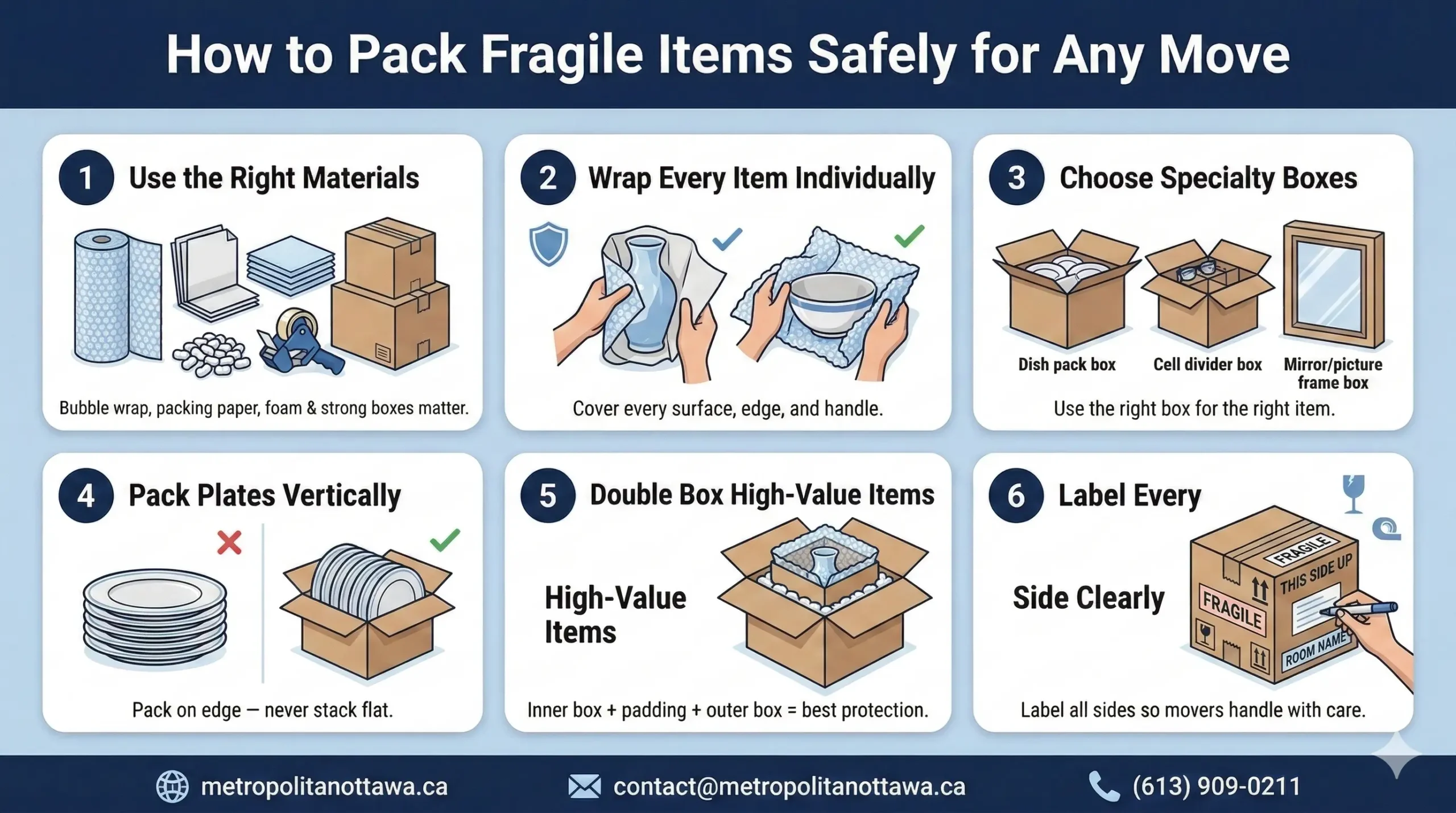
Dish pack boxes (also called dishware or china boxes) are double-walled cartons with thicker corrugated walls specifically designed to absorb impact during transit. They are the appropriate choice for plates, bowls, serving platters, and heavy ceramic cookware.
Cell divider boxes — also called glass pack or cell kit boxes — feature pre-cut cardboard dividers that create individual padded compartments for glasses, wine glasses, and stemware. Each glass sits in its own section without touching adjacent glasses, eliminating the primary cause of glass breakage during moves.
Mirror and picture frame boxes are adjustable telescoping boxes with two interlocking pieces that expand to fit different sizes. They are essential for framed artwork, mirrors, and large glass prints.
Wardrobe boxes with hanging rods are less relevant for breakables but worth mentioning for items like delicate sequined or beaded garments that would be damaged by folding.
For Ottawa residents managing a residential move with significant breakable inventory, having the correct box types on hand before packing begins is essential. Metropolitan Movers Ottawa can advise on box selection and quantities during the pre-move consultation stage.
The Double Boxing Method: The Gold Standard for High-Value Fragile Items
For items of significant monetary or sentimental value — fine china sets, collectibles, high-end electronics, valuable decorative pieces — the double boxing method provides the highest level of protection available in standard residential packing.
The process works as follows:
Step One: Wrap the item thoroughly with two to three layers of bubble wrap, securing each layer with packing tape without compressing the bubbles.
Step Two: Place the wrapped item into an appropriately sized inner box with at least two inches of cushioning material on all six sides — bottom, top, and all four walls. Crumpled packing paper or foam peanuts work well for this layer.
Step Three: Close and tape the inner box securely.
Step Four: Place the sealed inner box into a larger outer box, again surrounded by at least two inches of cushioning material on all sides. The inner box should not be able to shift in any direction inside the outer box.
Step Five: Fill any remaining void space in the outer box with additional cushioning and seal with quality packing tape applied in a H-pattern across all seams.
The outer box is what handlers touch. The inner box is what protects. The cushioning between them absorbs what neither box can deflect on its own. For items being moved from Ottawa to cities like Vancouver, Calgary, or Edmonton, where the distance and transit time increase the risk of vibration-related damage, double boxing is not optional — it is the professional standard.
Room-by-Room Fragile Packing Breakdown
Different rooms in a home present different fragile packing challenges. Approaching each room with a specific strategy saves time and reduces the likelihood of missed items.
Kitchen: China, Glassware, and Cookware
The kitchen typically contains the highest density of breakable items in any household. Plates should always be packed vertically on edge — never stacked flat. Flat stacking concentrates pressure on the bottom plates under the weight of those above. Packing plates vertically, like vinyl records in a crate, distributes weight across the corrugated edges of the dish pack box rather than through the ceramic itself.
Each plate should be individually wrapped in packing paper, with additional crumpled paper filling the gaps between each plate and the box wall. Use a dish pack box and fill every inch of void space — a box that rattles when shaken is a box that will produce casualties.
Living Room: Decorative Items, Sculptures, and Electronics
Decorative ceramics, figurines, and sculptures require generous bubble wrap coverage with particular attention to any protruding elements — handles, limbs, spouts, or narrow necks. These are the points where fractures originate. For sculptures with multiple protrusions, wrap each extension individually before wrapping the body.
For electronics, refer to the original manufacturer packaging whenever it is available — it is specifically engineered for that item’s dimensions and fragility profile. When original packaging is unavailable, the double boxing method with foam padding sheets and bubble wrap is the correct approach. For office moves that include sensitive electronics, Metropolitan Movers Ottawa provides professional packing and unpacking services with materials appropriate for commercial-grade equipment.
Dining Room: Crystal, Stemware, and Serving Pieces
Crystal stemware is among the most difficult category to pack safely due to its thin walls and narrow stems. Use cell divider boxes for all stemmed glasses. Wrap each glass individually in packing paper first — filling the interior bowl with crumpled paper before wrapping — and then apply a single layer of bubble wrap around the stem before placing in the divider cell.
Crystal decanters and serving bowls should be treated identically to high-value ceramics: individually wrapped in packing paper, covered in two layers of bubble wrap, and packed in an appropriately sized box with generous cushioning on all six sides.
Labeling and Box Orientation: The Details That Prevent Last-Minute Damage
Even perfectly packed boxes can sustain damage if they are handled incorrectly during loading and unloading. Proper labeling ensures that handlers at both ends of the move know exactly how to treat each carton.
Every fragile box should be labeled on all four vertical sides and the top, not just one face. Labels should include:
- FRAGILE in large, bold text on all visible sides
- THIS SIDE UP with a directional arrow on all four vertical sides
- HEAVY or LIGHT to indicate handling weight
- The room destination for efficient placement during unloading
Use a marker with thick ink that is visible from a distance. Adhesive fragile labels are a useful supplement but should not replace handwritten notation, which is more durable and less likely to peel during transit.
Moving Insurance for Fragile and High-Value Items
Standard moving coverage in Canada is limited and frequently misunderstood by homeowners. Most basic moving agreements include Released Value Protection — coverage based on weight rather than actual value, often at $0.60 per pound. For a valuable ceramic sculpture weighing two pounds, that translates to $1.20 in coverage — clearly inadequate for items worth hundreds or thousands of dollars.
For fragile items of significant value, additional coverage options worth exploring include:
- Full Value Protection through your moving company, which covers repair, replacement, or cash settlement at current market value
- Third-party moving insurance through a specialty insurer, which provides more comprehensive coverage and often covers items that movers’ policies exclude
- Homeowner’s or renter’s insurance riders that extend coverage to items in transit
The Government of Canada’s consumer protection resources provide guidance on insurance rights and responsibilities when transporting personal property across provincial boundaries — particularly relevant for long-distance moves from Ottawa to Montreal or Halifax.
Fragile Item Packing Checklist Before Moving Day
| Task | Status | Notes |
|---|---|---|
| Inventory all fragile items by room | Complete before packing begins | Photograph high-value items for insurance records |
| Source appropriate specialty boxes | At least 5–7 days before move | Dish packs, cell kits, mirror boxes as needed |
| Gather sufficient packing materials | Before packing day | Over-estimate — unused paper is returnable |
| Wrap all items individually | During packing | No item should touch another without padding between |
| Apply double boxing to high-value items | During packing | Minimum 2 inches of cushioning on all six sides |
| Pack plates vertically on edge | During packing | Never stack flat — distributes weight incorrectly |
| Label all fragile boxes on every side | After sealing each box | FRAGILE + THIS SIDE UP on all four vertical sides |
| Confirm moving insurance coverage | Before moving day | Full Value Protection or third-party rider recommended |
| Communicate fragile inventory to movers | On moving day | Walk movers through fragile boxes during loading |
| Inspect and photograph after unloading | Immediately on arrival | Document any damage before signing release forms |
When Professional Packing Is the Right Choice
There is a meaningful difference between being capable of packing fragile items yourself and having the time, materials, and experience to do it correctly under the pressure of a full household move. Professional packing and unpacking services from Metropolitan Movers Ottawa are worth serious consideration when:
- Your move includes a significant volume of china, crystal, or high-value collectibles
- You are completing a long-distance move to Winnipeg, Saskatoon, or another distant destination where transit time is extended
- You have limited time to pack before the moving date
- You are managing a senior relocation where the physical demands of wrapping and boxing are a concern
- You want the additional benefit of liability coverage that comes with professionally packed boxes
Metropolitan Movers Ottawa brings over 15 years of experience and uses professional-grade materials and techniques on every job — the same standards described throughout this guide, applied by trained hands who pack fragile items correctly every single time.
Frequently Asked Questions
What is the safest way to pack fragile items for a long-distance move?
The double boxing method combined with two to three layers of bubble wrap and generous cushioning on all six sides provides the highest level of protection for long-distance transit. Pair this with full value insurance coverage and clear fragile labeling on all box sides for a complete protection strategy.
Should I use bubble wrap or packing paper for dishes and glassware?
Both. Use packing paper as the primary wrap for dishes and glassware, and add a layer of bubble wrap for particularly delicate items. Always pack plates vertically on edge — never stacked flat — and use cell divider boxes for stemware to prevent glass-to-glass contact.
What boxes are best for china and breakable kitchenware?
Dish pack boxes — double-walled cartons with thicker corrugated construction — are the correct choice for china, plates, bowls, and heavy ceramic cookware. For glasses and stemware, cell divider box kits with individual padded compartments provide the most reliable protection.
How do I pack a television for moving?
Use the original manufacturer packaging whenever available. If unavailable, apply two to three layers of bubble wrap across the screen surface with foam padding sheets against the glass, then double box using a flat-screen TV box sized to allow two inches of cushioning on all sides. Always transport televisions standing upright — never flat.
Does Metropolitan Movers Ottawa offer professional packing for fragile items?
Yes. Metropolitan Movers Ottawa provides full professional packing and unpacking services for residential, senior, and office moves. The team uses industry-standard materials and techniques specifically suited to fragile and high-value items, with coverage options available for added peace of mind.
The Right Packing Technique Today Protects Everything You Value Tomorrow
Start Your Move the Smart Way with Metropolitan Movers OttawaPacking fragile items is one part knowledge, one part patience, and one part having the right materials on hand before you begin. Every tip in this guide — from packing plates on edge to mastering the double boxing method to confirming your insurance coverage — translates directly into fewer broken items and a less stressful moving day. The effort invested in correct fragile packing is always returned in the peace of mind that comes from opening boxes at your new home and finding everything exactly as you left it. When you are ready to move, Metropolitan Movers Ottawa is here to help — whether you need professional packing support, local moving services, or a fully managed long-distance relocation. Reach out today and move forward with confidence.