Packing is the single most time-consuming part of any move. Without a clear system, it turns into a chaotic sprint that damages belongings, wastes money, and drains your energy before moving day even arrives. This complete packing guide for moving eliminates that chaos with a proven, step-by-step approach.
Metropolitan Movers Ottawa has spent 15+ years packing and relocating thousands of households. We built this guide from the techniques our professional crews use daily — the same methods that prevent damage, save hours, and keep every box organized from start to finish. Check the moving rules and regulation
Whether you are wrapping your grandmother’s china or disassembling a home office, this packing guide covers everything. You will find a detailed packing timeline, room-by-room checklists, packing supplies lists, and expert packing tips movers rely on to protect your belongings during transit.
Why a Complete Packing Guide Matters
The average 3-bedroom home contains over 300 individual items that need wrapping, boxing, and labelling. Without a structured system, critical items get lost, fragile pieces break, and unpacking becomes a nightmare.
A complete packing guide for moving gives you a clear roadmap that answers three essential questions: what to pack, when to pack it, and how to protect it during transit.
Professional movers estimate that households using a structured packing checklist moving plan experience 60% fewer damaged items and unpack up to 40% faster. The upfront time you invest in following this guide pays back in speed, safety, and sanity.
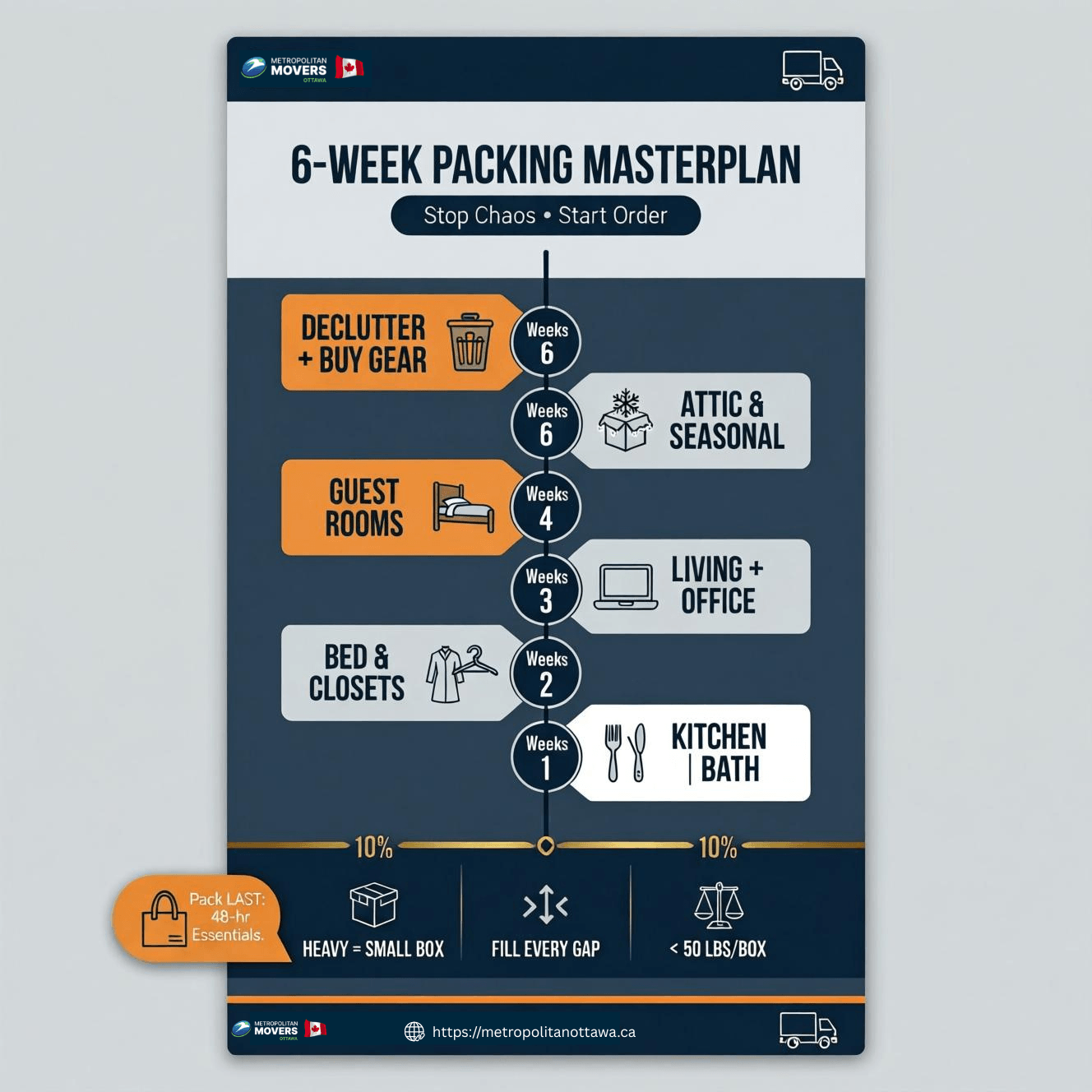
Your 6-Week Packing Timeline
Timing is everything when packing for a move. Start too late and you are throwing things into garbage bags at midnight. Start too early and you live out of boxes for weeks. This packing timeline gives you the perfect balance.
Following this packing timeline prevents the last-minute panic that leads to damaged items and forgotten belongings. Stick to it and your final days will be calm, organized, and efficient.
For a broader overview of your entire relocation schedule, review our complete moving guide covering every phase from planning through settling in.
Essential Packing Supplies List
Running out of tape or boxes mid-session kills momentum and wastes hours. Stock up on everything before you pack your first item.
Pro tip: Always buy 15% more packing supplies than you estimate. Running out mid-session costs you far more in lost momentum than a few extra boxes cost upfront.
Do not use newspapers for wrapping — the ink transfers permanently onto dishes, clothing, and linens. Invest in clean, unprinted packing paper.
Golden Rules of Packing Moving Boxes
Before you start packing moving boxes, memorize these fundamental rules. Every professional mover follows them, and so should you.
Rule 1: Heavy Items in Small Boxes, Light Items in Large Boxes
Books, tools, canned goods, and small appliances go in small boxes. Pillows, linens, lampshades, and stuffed toys go in large boxes. This keeps every box under 50 pounds and prevents bottom blowouts.
Rule 2: Fill Every Box Completely
A half-filled box collapses when stacked. Items inside shift and break during transit. Fill empty space with crumpled packing paper, towels, or soft clothing until the box feels firm but the lid closes without force.
Rule 3: Layer from Bottom Up
- Place 2–3 inches of crumpled packing paper at the bottom
- Position heaviest items on the bottom layer
- Add medium-weight items in the middle
- Place lightest and most fragile items on top
- Fill all gaps with crumpled paper
- Add a final protective layer before sealing
Rule 4: Tape All Seams
Seal every box with packing tape across the bottom, top, and side seams. A single strip across the top is not enough. Use the H-tape method — one strip along the centre seam and one strip across each end.
Rule 5: Never Exceed 50 Pounds Per Box
Even if you can lift heavier, your movers handle hundreds of boxes per day. Overloaded boxes cause injuries, slow down the process, and are the number one cause of box failure during transport.
Room-by-Room Packing Checklist
The most effective way to tackle your entire home is one room at a time. Complete each room before moving to the next. This packing checklist moving approach keeps items organized and makes unpacking significantly faster.
Living Room
- Remove batteries from all remotes and electronics
- Wrap picture frames individually in bubble wrap and pack vertically
- Disassemble shelving units and media stands — bag and label all hardware
- Roll area rugs tightly and secure with stretch wrap
- Pack books spine-down in small boxes
- Wrap lamps separately — remove bulbs and shades, pack base and shade in different boxes
- Place decorative items in medium boxes with generous padding
Bedrooms
- Use wardrobe boxes for all hanging clothing
- Vacuum-seal off-season clothing to save space
- Leave soft, lightweight clothing in dresser drawers — wrap dressers in stretch wrap to keep drawers closed
- Pack shoes in original boxes or wrap individually in packing paper
- Place jewellery in small zip-lock bags and carry personally
- Slide mattresses into mattress bags immediately before loading
Bathroom
- Dispose of expired medications, old cosmetics, and nearly empty bottles
- Seal every liquid container in a zip-lock bag to prevent leaks
- Pack toiletries you need daily in your essentials box (covered below)
- Wrap mirrors in bubble wrap with corner protectors and pack in mirror boxes or between cardboard sheets
Home Office
- Back up all computer files to cloud storage and an external drive before disassembling anything
- Photograph cable configurations behind your desk from multiple angles
- Label each cable with coloured tape or masking tape tags
- Pack monitors in original boxes if available — otherwise wrap in furniture blankets and mark “FRAGILE — SCREEN”
- Place documents in a waterproof file box and keep it with you
Garage and Outdoor
- Drain fuel from all gas-powered equipment (mower, trimmer, chainsaw)
- Dispose of hazardous materials properly (paint, chemicals, propane)
- Wrap sharp tools individually in thick cardboard or towels
- Disassemble outdoor furniture and bag all hardware
- Clean and dry all garden tools before packing
Packing Kitchen for Moving
The kitchen is the most challenging room in every home. It contains the highest concentration of fragile, heavy, and awkwardly shaped items under one roof. Packing kitchen for moving requires patience, technique, and the right supplies.
Appliances
- Empty and thoroughly clean every appliance (coffee maker, toaster, blender, Instant Pot)
- Wrap power cords in zip-lock bags and tuck them inside the appliance
- Pack each appliance in its original box if you kept it — original boxes provide the best protection
- If original boxes are unavailable, wrap in bubble wrap and place in a snug-fitting box with packing paper on all sides
- Seal and label each box with the appliance name
Pots, Pans, and Bakeware
- Nest pots and pans with a sheet of packing paper between each piece to prevent scratching
- Remove all lids and pack them vertically in a separate section of the same box
- Place cast iron items in their own small box — they are extremely heavy
- Wrap baking sheets and cutting boards in packing paper and stack vertically like file folders
Pantry and Food
- Use up as much food as possible in the weeks before your move
- Donate unopened, non-perishable items to a local food bank
- Dispose of all open packages, spices with no lids, and expired items
- Seal any items you are keeping in zip-lock bags to prevent spills
- Pack canned goods in small boxes — they are deceptively heavy
For a detailed strategy on loading all your kitchen boxes efficiently, check our guide on how to pack a moving container.
Packing Dishes and Glassware
Packing dishes is where most household damage occurs during a move. The techniques below are exactly what our professional crews use at Metropolitan Movers Ottawa.
Plates and Bowls
- Lay a stack of packing paper on your work surface
- Place one plate in the centre of the paper
- Fold corners over the plate snugly
- Place the next plate on top and repeat the wrapping
- Create bundles of 4–5 plates maximum
- Stand plate bundles vertically in the box — plates are strongest on their edges, not flat
Glasses and Stemware
- Stuff the inside of each glass with crumpled packing paper
- Wrap the entire glass in 2–3 sheets of packing paper, tucking ends inside
- Place glasses upside down in a box with cell dividers
- If no cell dividers are available, create individual nests using crumpled paper
- Never stack glasses on top of each other without dividers
Serving Dishes and Bowls
- Wrap each piece individually in bubble wrap
- Nest bowls with paper between each one
- Place platters and serving trays vertically between cardboard dividers
- Fill every gap in the box until nothing moves when you gently shake it
Critical Dish-Packing Rules
- Always place 3 inches of crumpled paper at the bottom of every dish box
- Never pack dishes flat in a stack — vertical positioning reduces breakage by up to 80%
- Label every dish box “FRAGILE” on all sides and the top
- Keep dish boxes away from the rear wall of the moving truck where vibration is highest
Packing Fragile Items Safely
Beyond dishes, your home contains dozens of fragile items that need individualized protection. Packing fragile items correctly is the difference between arriving intact and arriving in pieces.
Artwork and Framed Photos
- Place cardboard corner protectors on all four corners
- Wrap entirely in bubble wrap and secure with tape
- For glass-fronted frames, place an X of masking tape across the glass — this holds fragments together if it cracks
- Pack frames vertically in a flat, purpose-built picture box or between two pieces of rigid cardboard taped together
- Never lay framed items flat in a box
Vases and Ceramics
- Stuff the interior with crumpled packing paper
- Wrap the entire piece in bubble wrap — at least two layers for thin or delicate items
- Place in a snug box surrounded by crumpled paper on all sides
- Position the piece in the centre of the box, never touching the walls
Collectibles and Figurines
- Wrap each item in tissue paper first, then bubble wrap
- Use small boxes to limit movement
- If packing multiple figurines in one box, create individual compartments with cardboard dividers
- Mark the box “FRAGILE — DO NOT STACK”
Mirrors and Glass Tabletops
- Clean the surface first — dirt particles can scratch during transit
- Apply an X of masking tape across the glass
- Wrap in corner protectors, then a full layer of bubble wrap
- Slide into a mirror box or custom cardboard sleeve
- Always transport glass items vertically, never flat
For full professional support with fragile items, explore our packing and unpacking services designed for high-value and delicate belongings.
Packing Electronics for a Move
Modern homes contain thousands of dollars worth of electronics. Packing electronics requires specific precautions to prevent static damage, screen cracks, and connection confusion.
Computers and Monitors
- Back up all data to cloud and external drives
- Photograph all cable connections from every angle
- Label each cable with coloured masking tape (match the tape colour to the port)
- Disconnect all cables and bundle them with twist ties
- Remove ink cartridges from printers and seal in zip-lock bags
- Pack monitors in original boxes with original foam inserts — this is the gold standard
- If original packaging is gone, wrap the screen face in a soft microfibre cloth, then a furniture blanket, then secure with stretch wrap
Televisions
- Never lay a flat-screen TV flat in a box — transport upright at all times
- Original box and foam inserts are ideal
- Without original packaging, wrap in a furniture blanket and sandwich between two rigid pieces of cardboard cut to size
- Secure the entire assembly with stretch wrap
- Mark clearly: “FRAGILE — TV — THIS SIDE UP”
Gaming Consoles and Audio Equipment
- Remove all discs and store them in a separate case
- Wrap each unit in anti-static bubble wrap (pink-tinted)
- Bundle all cables and controllers in zip-lock bags labelled with the device name
- Pack in original boxes or in small boxes with firm padding on all sides
Smart Home Devices
- Remove smart devices from your accounts and reset to factory settings if you are not taking them
- For devices you are keeping, pack in small boxes with generous padding
- Keep voice assistants, routers, and hubs accessible — you may want to set up internet first at the new home
How to Pack Furniture for Moving
Furniture is the largest, heaviest, and most expensive category in most homes. Knowing how to pack furniture properly prevents scratches, dents, and structural damage during loading, transit, and unloading.
Disassembly Steps
- Photograph each piece from multiple angles before disassembly
- Remove legs, shelves, drawers, and detachable components
- Place all screws, bolts, and hardware in a labelled zip-lock bag
- Tape the hardware bag directly to the furniture piece it belongs to
- Keep allen keys and any specialized tools with the hardware
Wrapping and Protection
- Wood furniture: Wrap in furniture blankets secured with stretch wrap. Never apply tape directly to wood — it strips finish.
- Upholstered furniture: Cover entirely in stretch wrap to protect from dirt, moisture, and tears. Remove cushions and pack separately.
- Glass tabletops: Remove from bases. Apply masking tape X, wrap in bubble wrap, then sandwich between cardboard. Transport vertically.
- Mattresses: Slide into mattress bags immediately before loading. Seal the bag with tape.
Specific Furniture Pieces
| Furniture | Disassemble? | Wrap Method | Special Notes |
| Bed frame | Yes — remove headboard, footboard, rails | Blankets + stretch wrap | Bag all hardware, label per piece |
| Dining table | Yes — remove legs if possible | Blankets, corner protectors | Wrap legs individually |
| Sofa | Remove feet if possible | Stretch wrap entire piece | Protect arms and corners |
| Bookshelf | Remove shelves | Blankets + stretch wrap | Secure doors with stretch wrap |
| Desk | Remove drawers and shelves | Blankets | Tape drawers shut or remove |
| Dresser | Keep soft clothes inside | Stretch wrap to hold drawers | Remove heavy/breakable items |
If you have a piano, antique furniture, or other specialty items, Metropolitan Movers Ottawa offers piano moving services and furniture removal solutions handled by specifically trained professionals.
The Essentials Box: Your First-Night Survival Kit
This is the most important single box you will pack. It contains everything you need for your first 24–48 hours without digging through dozens of other boxes.
Pack this box last. Load it into your personal vehicle — not the moving truck. Bring it inside first at your new home.
What goes in the essentials box:
- Toiletries (toothbrush, toothpaste, soap, shampoo, deodorant)
- Medications and prescriptions
- Phone chargers and a power bank
- Change of clothes for each family member
- Pyjamas
- Bed sheets, pillows, and one towel per person
- Toilet paper and paper towels
- Basic cleaning supplies (all-purpose spray, garbage bags, paper towels)
- Snacks and water bottles
- Disposable plates, cups, and cutlery
- Basic tool kit (screwdriver, utility knife, pliers, tape measure)
- Important documents (ID, passports, lease/deed, insurance papers)
- Pet food, bowls, and a leash (if applicable)
- Children’s comfort items (favourite toy, blanket, tablet)
For a detailed post-move unpacking plan, follow our step-by-step how to unpack after moving guide.
Labelling System That Saves Hours
Your labelling system is the bridge between efficient packing and efficient unpacking. A bad label like “kitchen stuff” tells your movers nothing. A great label tells everyone exactly what is inside and where it belongs.
What to Write on Every Box
- Destination room — Bold and large on two sides and the top
- General contents — Brief description (e.g., “plates, bowls, serving dishes”)
- Box number — Sequential numbering for inventory tracking
- FRAGILE — On all sides if applicable
- THIS SIDE UP — For boxes with orientation-sensitive items
- ESSENTIALS — For your first-night box
Colour-Coding System
Assign one colour of tape or label to each room:
Place matching colour-coded signs on the door of each room in your new home. Movers can then deliver every box to the correct room without asking — saving massive time on moving day.
Items Movers Will Not Transport
Most professional moving companies maintain a list of prohibited items they cannot legally or safely transport. Know this list before you start packing to avoid surprises.
Items typically refused by movers:
- Propane tanks and gas cylinders
- Gasoline, kerosene, and motor oil
- Paints, stains, and solvents
- Household chemicals and cleaning agents (bleach, ammonia)
- Ammunition and firearms (require special transport)
- Fireworks and flares
- Perishable food items
- Live plants (on long-distance moves)
- Pets (always transport personally)
- Personal documents and irreplaceable items (carry with you)
- Prescription medications (keep in your essentials box)
Plan to transport these items yourself, dispose of them responsibly, or donate them before moving day. If you are planning a long-distance relocation, check the specific regulations for your route — for example, interprovincial moves like Toronto to Vancouver or Toronto to Calgary may have additional restrictions.
Common Packing Mistakes to Avoid
After 15+ years of professional moving experience, our team has seen every packing mistake imaginable. These are the most common — and the most costly.
1. Starting the Week Before the Move
This is the single biggest mistake. One week is not enough to properly pack a 2-bedroom apartment, let alone a house. Follow the 6-week packing timeline outlined in this complete packing guide for moving and you will never face last-minute chaos.
2. Using the Wrong Box Sizes
Packing heavy books in a large box creates an unliftable, breakable disaster. Packing pillows in a small box wastes dozens of boxes. Match item weight to box size every single time.
3. Ignoring the Inside of Boxes
A beautifully labelled box means nothing if the items inside are loose, unwrapped, and smashing into each other. Every item needs individual wrapping. Every gap needs filling. No exceptions.
4. Not Protecting Furniture Surfaces
One scratch across a dining table costs more to repair than a full roll of stretch wrap. Wrap every furniture surface in blankets. Use corner protectors on all edges. Never let wood touch wood.
5. Packing Dishes Flat
Plates stacked flat in a box break under their own weight during transit. Standing them vertically like records reduces breakage dramatically. This one change alone saves most kitchens from damage.
6. Forgetting to Photograph Electronics
Without photos of your cable setup, you will spend hours guessing which cable goes where at your new home. Take pictures before unplugging a single cord.
7. Skipping the Essentials Box
Arriving at your new home with no toilet paper, no charger, no sheets, and no way to open boxes is a miserable experience. Pack your essentials box the night before and keep it with you.
FAQ: Complete Packing Guide for Moving
How far in advance should I start packing?
Start your packing timeline six weeks before your move date. This gives you adequate time to declutter, gather packing supplies, and work through each room systematically without last-minute pressure.
What room should I pack first?
Pack the rooms you use least first — storage areas, the attic, basement, garage, and guest rooms. Save the kitchen and bathrooms for last since you use them daily until moving day.
How many boxes do I need for a 3-bedroom house?
A typical 3-bedroom house requires approximately 20 small boxes, 35 medium boxes, 25 large boxes, 6 wardrobe boxes, and 2 dish pack boxes. Always buy 15% more than you estimate.
What is the best way to pack fragile items?
Wrap each fragile item individually in packing paper or bubble wrap. Place 3 inches of crumpled paper at the bottom of the box. Fill all gaps so nothing shifts. Label every fragile box on all sides and the top.
Should I pack cleaning supplies separately?
Yes. Keep a small caddy of basic cleaning supplies out of your packed boxes. You need them to clean your old home after loading and to wipe down surfaces at your new home before unpacking.
Can I leave clothes in dresser drawers when moving?
Soft, lightweight clothing can stay in dresser drawers. Wrap the dresser in stretch wrap to keep drawers closed during transit. Remove all heavy items, breakables, and liquids from drawers before moving.
How do I pack a flat-screen TV without the original box?
Wrap the screen face in a soft microfibre cloth. Cover the entire TV in a furniture blanket. Sandwich between two rigid pieces of cardboard cut to size. Secure with stretch wrap. Transport upright only.
What should I do with items movers won’t transport?
Dispose of hazardous materials responsibly at a local hazardous waste facility. Transport personal documents, medications, and valuables in your personal vehicle. Donate perishable food to a local food bank.
How do I prevent boxes from breaking during the move?
Never exceed 50 pounds per box. Tape all seams using the H-tape method. Fill every box completely so contents cannot shift. Use quality, corrugated moving boxes — not thin recycled boxes from the grocery store.
Is it worth hiring professional packers?
Professional packers save significant time and reduce damage risk, especially for large households, fragile collections, or time-sensitive moves. Metropolitan Movers Ottawa offers full packing and unpacking services tailored to any household size and timeline.
Conclusion
Packing does not have to be overwhelming when you follow a structured system. This complete packing guide for moving has given you every tool you need — a 6-week packing timeline, detailed packing supplies lists, room-by-room checklists, and professional techniques for packing fragile items, packing dishes, packing electronics, and packing furniture.
The packing tips movers use daily are now in your hands. Start early, work one room at a time, label everything clearly, and protect every item individually. These are the packing fundamentals that separate a smooth move from a stressful one.
Remember: the effort you invest in proper packing pays back tenfold during unpacking. When every box is labelled, every item is padded, and every room is organized, you will settle into your new home faster than you thought possible.
Metropolitan Movers Ottawa has spent 15+ years perfecting these techniques across thousands of relocations. Whether you need full-service residential moving in Ottawa, local moving services in Orleans, or office moving support, our trained professionals handle every box like it contains something irreplaceable — because it does.
Ready to get started? Contact us today for a personalized moving and packing estimate.