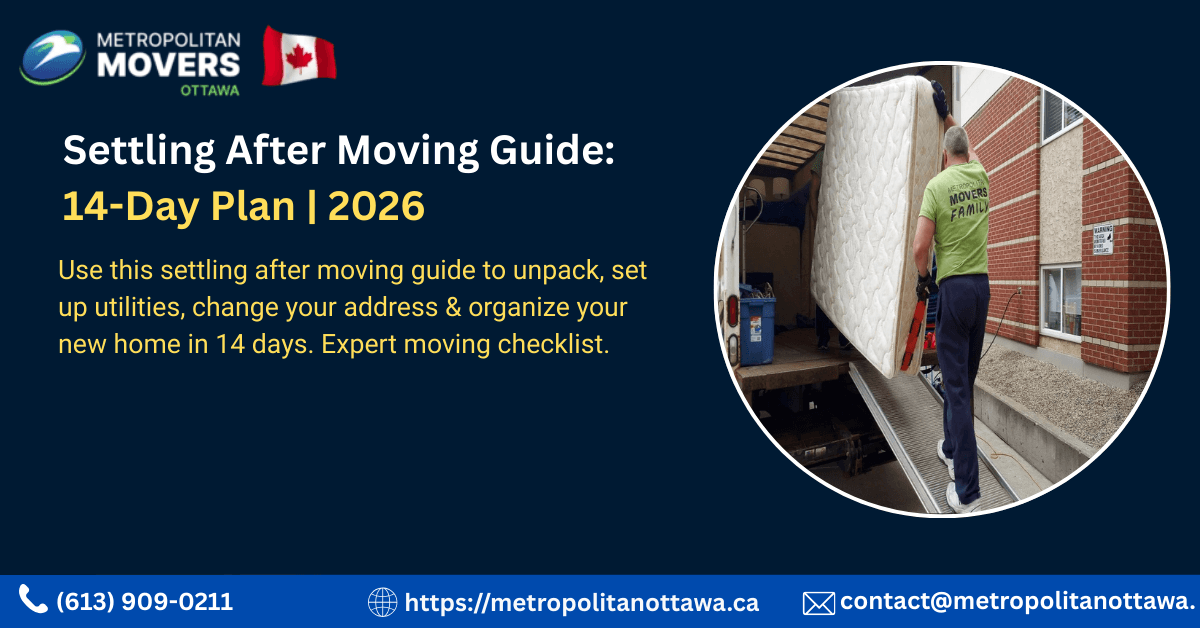
The truck is gone. The boxes are stacked. The movers have left. And now the real work begins — transforming a house full of cardboard into a home that actually functions. This settling after moving guide gives you a structured, day-by-day plan that takes you from moving day chaos to fully settled comfort in just 14 days.
Metropolitan Movers Ottawa has spent 15+ years helping Canadians not just move, but truly settle into their new homes. We have watched thousands of families navigate this transition, and the ones who thrive all share one thing in common: they follow a system. This guide is that system. Moving rules and regulation
Your first week after moving sets the foundation for everything — how quickly your household functions, how fast your family adjusts, and how efficiently you handle the dozens of administrative tasks that follow a relocation. Whether you are unpacking after moving across town or setting up a brand new life after a cross-province relocation, this post moving checklist covers every step from your first night through your second full week.
Why the First 14 Days Matter Most
The first two weeks after a move are the most critical period of your entire relocation. Studies show that households who unpack and organize within 14 days report significantly lower stress levels and faster adjustment to their new community.
Every day you live out of boxes adds friction to your daily routine. You cannot find the coffee maker. The kids cannot find their school supplies. Important documents are buried somewhere in box 37 of 52. This settling after moving guide eliminates that chaos with a structured approach.
The difference between families who settle quickly and those who still have unopened boxes six months later is not energy or motivation — it is having a plan. Follow this new home checklist day by day, and you will be fully settled, organized, and connected to your new neighbourhood before the two-week mark.
For the complete planning and packing framework that leads up to this moment, explore our complete moving guide covering every phase from 8 weeks out through moving day.
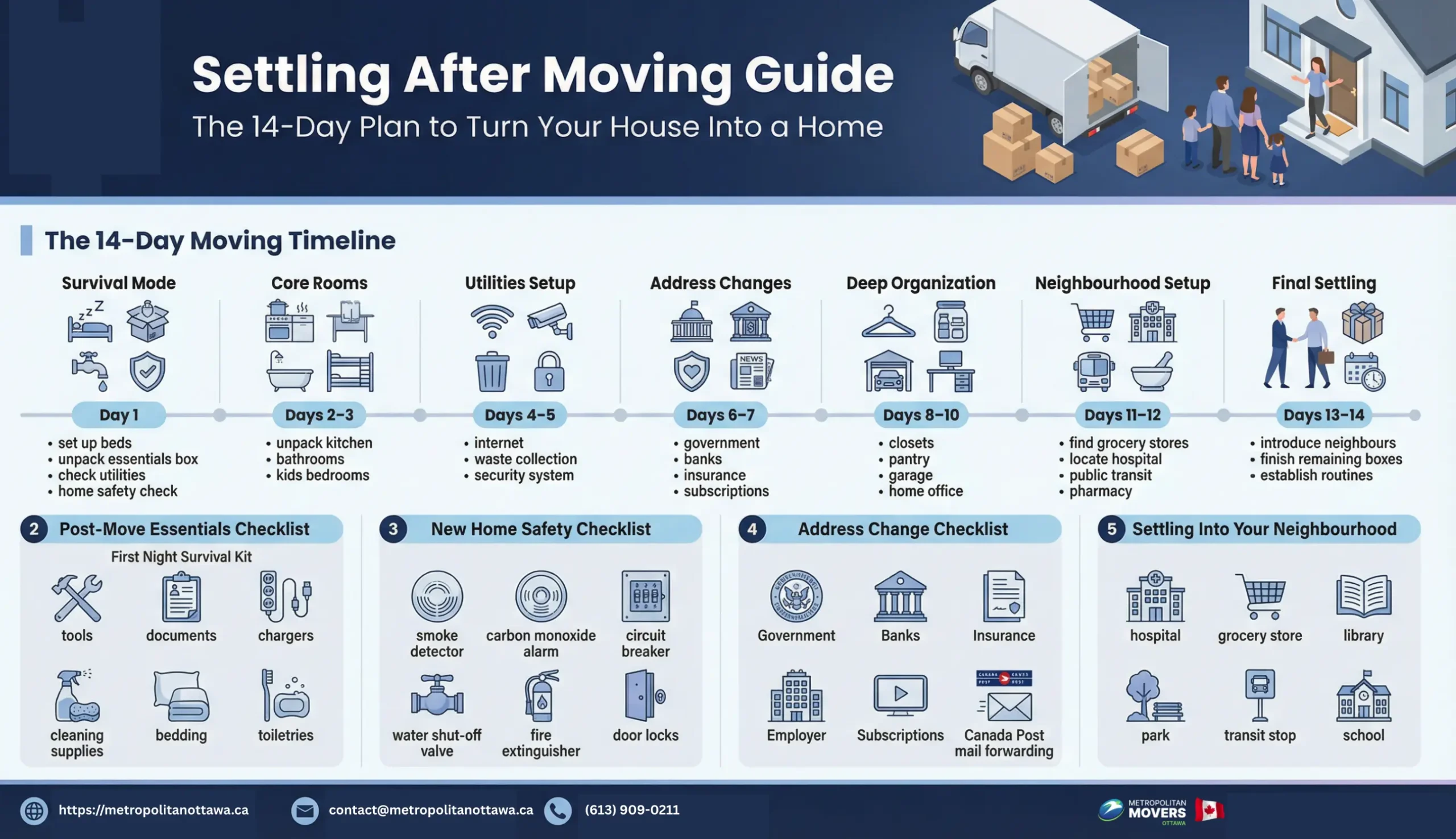
Your 14-Day Settling After Moving Timeline
This moving house setup timeline gives you a bird’s-eye view of the entire settling process. Each phase is expanded in detail in the sections below.
This timeline turns the overwhelming post-move period into manageable daily objectives. Tackle each phase in order and you will never feel buried under the weight of everything that needs to happen.
Day 1: Immediate Priorities at Your New Home
Day 1 is survival mode. You are exhausted from moving day. Your home is full of boxes. Your goal is not to unpack everything — it is to establish the basics so your household can function, sleep, and eat tonight.
Priority 1: Set Up All Beds (45 Minutes)
This is the single most important task on Day 1. Every person in your household needs a made bed with sheets, pillows, and blankets ready before anything else happens. You will be exhausted tonight — do not let assembling bed frames be the last thing standing between you and sleep.
Priority 2: Unpack the Essentials Box (20 Minutes)
Your essentials box — the one that travelled in your personal vehicle — contains your first-night survival kit. Unpack it now:
- Place toiletries in the main bathroom
- Plug in phone chargers in the bedroom and kitchen
- Set out cleaning supplies, paper towels, and garbage bags
- Position snacks and water bottles on the kitchen counter
- Place important documents in a secure, accessible spot
- Set out the basic tool kit (screwdriver, utility knife, pliers)
Priority 3: Verify All Utilities (15 Minutes)
Walk through the home and confirm every utility is active:
- Hot and cold water in multiple sinks, tubs, and showers
- Electricity in every room (test light switches and outlets)
- Gas appliances functioning (stove, furnace, hot water tank)
- Thermostat set to a comfortable temperature
- Internet connected (if pre-arranged)
Priority 4: Home Safety Essentials (15 Minutes)
- Install fresh batteries in all smoke detectors and carbon monoxide alarms
- Locate the circuit breaker panel
- Locate the main water shut-off valve
- Locate the furnace and HVAC controls
- Confirm all exterior doors and windows lock properly
- Test the security system (if applicable)
Priority 5: Order Dinner and Rest
You have earned it. Order food, eat together as a family, and go to bed. Tomorrow is unpacking day — not tonight.
Days 2–3: Unpacking After Moving — The Core Rooms
Unpacking after moving works best when you tackle the most impactful rooms first. These are the spaces your household uses hourly — the kitchen, bathrooms, and children’s bedrooms.
The Unpacking Priority Order
Unpacking Efficiency Tips
- Unpack one room completely before starting the next. Half-unpacked rooms across the house create visual chaos and slow your progress.
- Break down boxes immediately after emptying. Flatten cardboard and bundle it for recycling. Empty boxes stacked inside rooms block walkways and create a cluttered feeling.
- Place shelf liner before loading shelves and drawers. This is the only time you will have empty surfaces — take advantage.
- Do not aim for perfection. Get functional first. Reorganize and fine-tune placement during Week 2.
For a detailed room-by-room unpacking strategy, follow our how to unpack after moving guide with professional sequencing techniques.
Days 4–5: Setting Up Utilities and Essential Services
By Days 4–5, your core rooms should be functional. Now it is time to ensure every service your household depends on is fully active and configured.
Utility Setup Verification Checklist
Setting Up Utilities — Pro Tips
- Schedule internet installation before your move-in date. Working internet on Day 1 is essential for remote workers, children doing homework, and staying connected during the transition.
- Take meter readings for electricity and gas on the day you move in. Photograph the meters for your records. This protects you from being billed for the previous occupant’s usage.
- Learn your waste collection schedule immediately. You will generate enormous amounts of cardboard and packing material in the first week. Missing the first recycling pickup means living with mountains of flattened boxes.
- Set up autopay for all utilities once accounts are confirmed. This prevents missed payments during the chaotic first month.
Days 6–7: Change Address After Moving — Master Checklist
Changing your address after moving is one of the most tedious but essential tasks in your post moving checklist. Miss a single entity and you risk lost mail, lapsed coverage, or administrative complications that surface months later.
Complete Change of Address Checklist
Pro tip: Set up Canada Post mail forwarding before your move — not after. Forwarding catches mail from entities you forget to notify directly. The $75–$120 annual cost is insignificant compared to missing a tax notice, renewal, or important letter.
Week 2, Days 8–10: Organizing New Home Room by Room
With your core rooms functional and utilities active, Week 2 shifts to deep organizing new home spaces. This is where your house starts feeling like home.
Kitchen Organization
The kitchen is the heart of your home and the most organizational-intensive room.
- Wipe all shelves and drawers with a damp cloth before loading anything
- Install shelf liner in all cabinets and drawers (this is the only chance you will have with empty surfaces)
- Place everyday dishes at eye level for easy access
- Store rarely used items (seasonal cookware, entertaining platters) in upper or lower hard-to-reach cabinets
- Organize the pantry with categories: baking, canned goods, snacks, spices, grains, pasta
- Set up a junk drawer with tape, scissors, pens, batteries, and small tools — every home needs one
- Position appliances on the counter based on daily use frequency
Closet and Wardrobe Organization
- Hang clothing by category (work, casual, seasonal) and colour within each category
- Install a shoe rack or over-the-door organizer immediately — shoes on the closet floor create instant chaos
- Place folded items (sweaters, t-shirts) on shelves or in drawer organizers
- Store off-season clothing in vacuum-seal bags on the top shelf
Garage and Storage Areas
- Install wall hooks and pegboards for tools, sports equipment, and garden supplies
- Place frequently used items (snow shovel, bicycle, toolbox) in the most accessible positions
- Store seasonal items (holiday decorations, camping gear) in labelled bins on higher shelves
- Keep a clear pathway to the circuit breaker, water shut-off, and furnace at all times
Home Office Setup
- Position your desk near natural light and a power outlet
- Reconnect monitors, printers, and peripherals using the cable photos you took during packing
- Install a cable management system under the desk to prevent tangling
- Set up file storage for important documents
If you need your home office or business workspace relocated professionally, Metropolitan Movers Ottawa offers office moving services with IT disconnection and reconnection support.
Week 2, Days 11–14: Adjusting to New Neighbourhood
Adjusting to new neighbourhood surroundings is one of the most overlooked parts of settling in. Knowing where everything is — from the nearest hospital to the best grocery store — transforms a foreign location into a community you belong to.
Local Services to Locate in Week 2
- Nearest hospital and urgent care clinic — Know the address and fastest route before you need it
- Family doctor, dentist, and pharmacy — Register as new patients. Transfer prescriptions to the local pharmacy.
- Grocery stores — Find your primary and backup options. Learn their hours.
- Post office — Know where to pick up registered mail and packages
- Library — Free resource for books, events, workspace, and community connection
- Parks and recreation — Locate the nearest playgrounds, trails, dog parks, and community centres
- Public transit routes — Download the local transit app and learn the nearest stops
- Gas stations and car services — Identify the most convenient fuelling and maintenance options
- Schools — If applicable, visit the school your children will attend. Meet the office staff and tour the grounds.
Building Community Connections
- Introduce yourself to immediate neighbours within the first two weeks. A simple knock, a smile, and your name go a long way toward building community.
- Join a local online group — Facebook neighbourhood groups, Nextdoor, or community forums connect you to local information and events.
- Attend a community event — Farmers’ markets, library programs, recreation centre activities, and neighbourhood association meetings are easy entry points.
- Walk the neighbourhood daily — Physical exploration builds mental maps and creates organic encounters with neighbours.
If you recently moved to the Ottawa area, our first week after moving to Ottawa guide covers neighbourhood-specific resources, local registrations, and community connection opportunities.
Explore our area pages for neighbourhood-specific information: Ottawa, Kanata, Nepean, Orleans, or Gatineau.
New Home Safety and Security Checklist
Home setup after moving is not complete without a thorough safety and security audit. This is especially important if the home had previous occupants.
Security Tasks
- Re-key or replace all exterior locks — You do not know who has copies of the previous keys
- Change the garage door code if applicable
- Update the security system code and register your contact information
- Install deadbolts on any exterior door that lacks one
- Check all window locks and replace any that are broken or stiff
- Install motion-sensor exterior lighting at front and back entrances
- Set up a video doorbell or camera system if desired
Safety Tasks
- Test all smoke detectors — Install fresh batteries or replace units older than 10 years
- Test carbon monoxide detectors — Required on every floor and near sleeping areas
- Locate and label the circuit breaker panel — Identify which breaker controls each zone
- Locate the main water shut-off valve and test it
- Inspect fire extinguishers — Check the gauge and replace if expired. Place one on each floor.
- Check for radon — Radon testing kits are inexpensive and available at hardware stores (especially important in certain Canadian regions)
- Create a family emergency plan — Identify two exits from every room, designate an outdoor meeting point, and share emergency contact numbers
Emergency Information Card
Create a card and post it on the inside of a kitchen cabinet door:
- Home address (for giving to emergency services)
- Poison control number
- Nearest hospital name and address
- Family doctor contact
- Home insurance policy number
- Utility emergency numbers (gas leak, electrical emergency, water main)
- Neighbour emergency contact
Canadian-Specific Post-Move Admin Tasks
If you moved within Canada — particularly between provinces — there are specific administrative requirements that your post moving checklist must include.
Interprovincial Move Tasks
If you crossed a provincial border, you must complete these tasks within the deadlines specified by your new province:
- Apply for a new provincial health card — Most provinces allow 3 months, but apply immediately to minimize the waiting period gap
- Exchange your driver’s licence — Typically required within 60–90 days. Bring your current licence, proof of address, and government ID
- Register your vehicle — Many provinces require a safety inspection before registration. Budget $100–$200 for the inspection
- Update your auto insurance — Your policy must reflect your new province. Rates change significantly by province and postal code
- Notify CRA of your new address — This ensures tax correspondence and benefit payments (CCB, GST/HST credit) reach you without interruption
For detailed guidance on interprovincial registration deadlines and requirements, review our long-distance movers resource hub with route-specific preparation advice.
Within-Province Move Tasks
Even for local moves within the same province, you still need to:
- Update your driver’s licence address (typically required within 6 days in Ontario)
- Update vehicle registration address
- Notify your municipality for property tax and waste collection
- Update your home insurance policy address
- Set up Canada Post mail forwarding
Moving House Setup for Families With Kids and Pets
Settling into a new home is an adjustment for every family member. Children and pets need extra attention during this transition to feel secure and comfortable.
Helping Kids Settle In
- Set up their bedrooms first — Familiar bedding, favourite toys, and personal items create an anchor of comfort
- Maintain routines as much as possible — Same bedtimes, meal times, and daily habits reduce anxiety
- Explore the neighbourhood together — Walk to the park, find the nearest ice cream shop, locate their school route
- Arrange playdates early — If you have neighbours with children of similar age, facilitate introductions
- Be patient with emotions — Moving is disorienting for kids. Allow extra time for adjustment and be available for conversation
- Register for extracurriculars — Sports teams, music lessons, art classes, and library programs accelerate social connection
Helping Pets Adjust
- Set up their space immediately — Place food bowls, water, bed, and toys in a consistent location from Day 1
- Keep them confined initially — Let pets explore one room at a time rather than the entire house at once. Gradual exposure reduces anxiety.
- Maintain feeding and walking schedules — Routine is the most powerful comfort tool for pets
- Update microchip and ID tag information with your new address and phone number
- Find a new veterinarian — Transfer records and schedule an introductory visit within the first month
- Watch for stress signs — Loss of appetite, excessive hiding, or unusual behaviour may indicate adjustment difficulty. Consult your vet if symptoms persist.
If you relocated with elderly family members, our team offers specialized moving services for senior citizens with gentle handling and personalized settling-in support.
Common Post-Move Mistakes to Avoid
After 15+ years of helping families settle in, Metropolitan Movers Ottawa has identified the mistakes that slow down the settling process and create unnecessary stress.
1. Trying to Unpack Everything on Day 1
This is the fastest path to burnout. Follow the 14-day timeline in this settling after moving guide and pace yourself. Day 1 is for beds, essentials, and utilities — not for hanging pictures and organizing the garage.
2. Ignoring the Address Change Checklist
Every entity you forget to notify creates a potential problem weeks or months later — missed bills, lapsed insurance, lost government correspondence, or packages delivered to your old address. Work through the change address after moving checklist systematically on Days 6–7.
3. Not Setting Up the Kitchen Early
Every day without a functional kitchen costs $30–$80 in takeout food for a family. Unpack the kitchen on Day 2 and you will save hundreds in your first week alone.
4. Keeping Packing Materials Too Long
Flattened boxes, used packing paper, and bubble wrap take up enormous space. Break down and recycle packing materials the same day you empty each box. Your home will feel bigger and calmer immediately.
5. Neglecting Self-Care
Moving is physically and emotionally exhausting. Skipping meals, not drinking water, and working 14-hour days creates burnout that derails the entire settling process. Eat well, hydrate, take breaks, and sleep a full night.
6. Forgetting to Change the Locks
You do not know who has copies of the previous owner’s or tenant’s keys. Re-key or replace all exterior door locks within the first 48 hours.
7. Not Meeting Your Neighbours
Introducing yourself to neighbours within the first two weeks creates a foundation for community, mutual support, and belonging that pays dividends for years.
FAQ: Settling After Moving Guide
How long does it take to fully settle into a new home?
Most households feel functionally settled within 14 days if they follow a structured plan. Full emotional adjustment — feeling like the house is truly “home” — typically takes 3–6 months.
What room should I unpack first?
Unpack the kitchen first. A functional kitchen allows you to prepare meals at home from Day 2, saving hundreds on takeout and creating a sense of normalcy. Bathrooms and children’s bedrooms should follow immediately after.
How quickly should I change my address after moving?
Begin the change address after the moving process within the first week. Set up Canada Post mail forwarding before or on moving day. Update government, financial, insurance, and employer records by Day 7.
When should I set up the internet at my new home?
Schedule internet installation before your move-in date so it is active on Day 1. Working on the internet is essential for remote work, children’s homework, and staying connected during the transition.
Should I re-key the locks at my new home?
Yes. Re-key or replace all exterior locks within 48 hours of moving in. You cannot know who has copies of the previous keys, making this an essential security step.
How do I help my kids adjust to a new home?
Set up their bedrooms first, maintain familiar routines, explore the neighbourhood together, arrange playdates with new friends, and register for activities quickly. Be patient — adjustment takes time.
What is the most important thing to do on Day 1?
Set up beds for every person in your household. Sleep is non-negotiable after the exhaustion of moving day. A made bed with clean sheets is your number one priority before anything else.
How do I find a new doctor after moving?
Ask neighbours for recommendations, search your provincial health authority’s online directory, or call the local hospital for a list of physicians accepting new patients. Transfer your medical records from your previous provider.
When should I introduce myself to neighbours?
Within the first two weeks. A simple knock, your name, and a friendly greeting are all it takes. Early introductions build community and create a mutual support network.
Do I need to update my health card if I moved to a new province?
Yes. Apply for your new provincial health card as soon as possible after arrival. Most provinces allow up to 3 months, but there may be a waiting period before coverage activates. Maintain your previous province’s coverage or purchase private travel health insurance during the gap.
Conclusion
The first 14 days after a move define your entire settling experience. This settling after moving guide has given you a structured day-by-day plan that transforms a house full of boxes into a functional, comfortable, and connected home. From unpacking after moving in the right sequence, to setting up utilities, to completing every item on your change address after moving checklist, to adjusting to new neighbourhood life — every phase is mapped out and actionable.
Your post moving checklist does not end when the boxes are empty. Organizing new home spaces, establishing safety systems, registering with local services, and building community connections are equally important steps that this home setup after moving guide covers in detail.
The families who settle fastest are the ones who follow a plan, pace themselves, and tackle one phase at a time. Your new home checklist is now complete — trust the process, work through each day’s priorities, and allow yourself the grace to adjust gradually.
Metropolitan Movers Ottawa has supported thousands of families through every phase of relocation for 15+ years — from the first planning conversation through full settling-in support. Whether you need residential moving in Ottawa, local moving in Orleans, house moving in Nepean, furniture moving in Kanata, packing and unpacking services, or piano moving with specialized care, our trained professionals deliver consistent excellence on every job.
Explore all of our moving services or learn more about our company and our commitment to stress-free relocations. Planning a long-distance move across Canada? We handle every corridor with binding estimates and professional care. Need storage between homes or a last-minute moving team? We have you covered.
Ready to start your move? Contact us today for a personalized estimate from our relocation specialists.