Moving across provinces is one of the most complex relocations a Canadian household will face. The distances are vast, the logistics are layered, and the administrative tasks multiply with every provincial border you cross. This long distance moving guide breaks down the entire process into clear, manageable phases so nothing catches you off guard.
Metropolitan Movers Ottawa has spent 15+ years executing successful long distance relocations across every major Canadian corridor. We built this guide from thousands of real cross province moves — the same strategies our professional crews follow to deliver households safely from coast to coast. Check the moving rules and regulation
Whether you are planning interprovincial moving from Toronto to Vancouver or a shorter corridor like Ottawa to Montreal, this resource gives you everything you need. You will find a detailed long distance moving timeline, cost breakdowns by route, a complete long distance moving checklist, furniture shipping strategies, and expert tips for navigating provincial requirements at your destination.
What Qualifies as a Long Distance Move in Canada?
In Canada, a long distance move is generally defined as any relocation exceeding 100 kilometres. However, the term takes on real significance when you cross provincial boundaries — that is where interprovincial moving introduces unique regulatory, logistical, and financial challenges.
A local move across Ottawa takes 4–8 hours. A long distance relocation from Toronto to Calgary takes 5–8 days and covers 3,400 kilometres of highway. The planning, pricing, insurance, and administrative requirements are fundamentally different.
This long distance moving guide covers both types — long hauls within a province and full cross province moves that take your household to an entirely new region of the country.
For a broader overview that includes local move preparation, explore our complete moving guide on the Metropolitan Movers Ottawa blog.
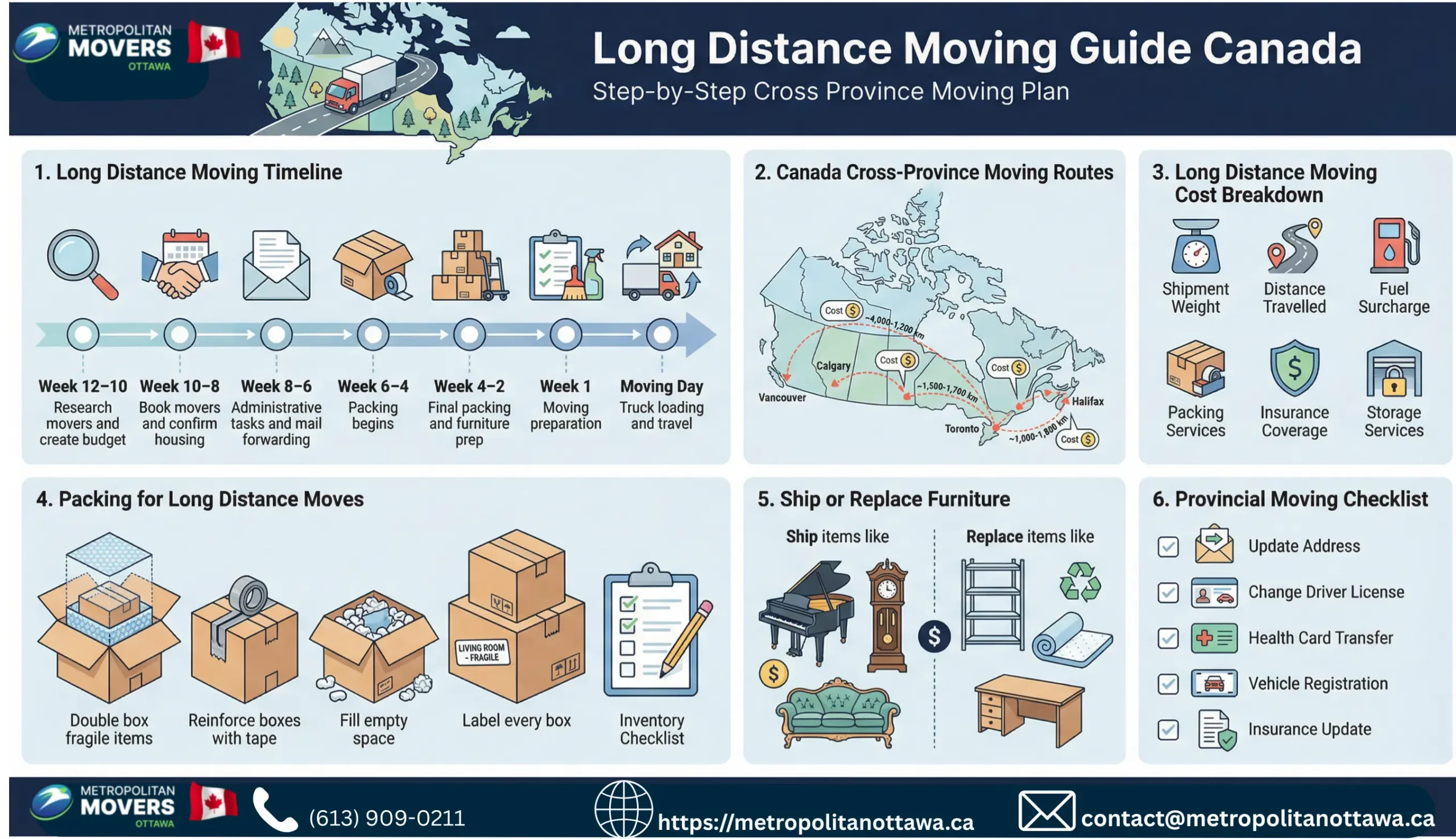
Your 12-Week Long Distance Moving Timeline
Long distance relocation requires more lead time than a local move. Start your long distance moving preparation at least 12 weeks before your move date. This timeline keeps every task on schedule.
This long distance moving timeline accounts for the extended lead times that cross province moves demand — booking movers 8–12 weeks ahead, coordinating housing at both ends, and managing provincial paperwork that local moves never require.
How Much Does Moving Across Canada Cost?
The long distance moving cost varies dramatically based on shipment weight, distance, timing, and services selected. Below are realistic 2026 estimates for a standard 2–3 bedroom household moving across Canada.
These estimates include loading, linehaul transportation, and unloading. Professional packing, insurance upgrades, storage, and specialty item handling are additional. Always request a binding estimate that locks in your maximum price.
For a comprehensive breakdown of every cost category, explore our moving cost guide covering local, long distance, and cross-country pricing in detail.
City-to-City Long Distance Moving Cost Breakdown
Specific route pricing makes your budget real. Below are estimated costs for a standard 2–3 bedroom household on the most popular Canadian long distance corridors.
Each route link leads to a detailed guide with route-specific pricing, timeline, and preparation advice. Click any route above for granular information tailored to your exact destination.
For a full overview of all corridors we serve, visit our long-distance movers service hub.
How Long Distance Movers Calculate Your Price
Understanding moving across Canada pricing protects you from surprises. Long distance movers use a weight/distance model with several layers.
The Pricing Formula
- Inventory assessment — The mover estimates your total shipment weight or cubic footage via an in-home or virtual survey
- Linehaul rate — Your per-pound rate multiplied by the total distance between origin and destination
- Origin services — Loading, packing, furniture disassembly, and floor protection at your current home
- Destination services — Unloading, reassembly, and placement at your new home
- Fuel surcharge — Typically 8–18% of the linehaul cost
- Valuation coverage — Basic liability is included; full replacement value is recommended but adds 1–3% of declared value
- Additional services — Storage, shuttle truck, extra stops, crating, or vehicle transport
What Drives Your Price Up or Down
- Shipment weight — Every item you eliminate through decluttering saves money directly
- Distance — Longer routes cost more in fuel, crew hours, and equipment wear
- Seasonality — May through September commands 10–25% higher rates
- Access difficulty — Stairs, narrow hallways, long carries, and elevator wait times all add surcharges
- Specialty items — Pianos, hot tubs, safes, and antiques require specialized handlers
If you are downsizing before your move, reducing your shipment weight is the single most effective way to lower your long distance moving cost.
How to Choose Reliable Long Distance Movers
Selecting the right long distance movers is the most consequential decision in your entire relocation. A great mover protects your belongings, respects your timeline, and delivers transparent pricing. A poor one does the opposite.
What to Look For
- Interprovincial experience — Ensure the company regularly handles cross province moves, not just local jobs
- Binding estimates — A binding estimate locks in your maximum price. Non-binding estimates are guesses that can legally increase 15–25%
- Insurance options — Basic carrier liability ($0.60/lb) is inadequate for most households. Look for full replacement value coverage
- Clear communication — Responsive, proactive customer service from quote through delivery
- Licensed and insured — Verify membership in the Canadian Association of Movers (CAM) or equivalent credentials
- Detailed written contract — Every charge, service, and timeline should be documented
Red Flags to Avoid
- Quotes given over the phone without seeing your inventory
- Demands for large upfront cash deposits
- No physical business address or office
- Vague pricing with undefined “additional fees”
- No written contract or bill of lading
- Unmarked trucks or crews without uniforms and identification
Metropolitan Movers Ottawa provides transparent, binding estimates for every long-distance route with no hidden fees. Our crews are trained, uniformed, and insured on every job.
Packing Strategies for Cross Province Moves
Packing for a long distance relocation demands higher standards than a local move. Your belongings will spend days in transit across thousands of kilometres of highway, facing vibration, temperature changes, and multiple handling points.
Long Distance Packing Rules
- Double-box fragile items — Place the inner wrapped item in a small box, then nestle that box inside a larger box with cushioning on all sides
- Reinforce every box bottom — Use the H-tape method (centre seam + both end seams) with professional packing tape
- Fill every gap — Items shift more during long-distance transit. Crumpled packing paper or towels in every empty space prevents movement
- Use new, quality boxes — Avoid reused grocery store boxes. They lack structural integrity for extended transit
- Seal liquids in zip-lock bags — Temperature changes during transit can cause lids to loosen and leak
- Create a detailed inventory list — Number every box and record its contents. This is essential for insurance claims and for verifying delivery
Room-by-Room Packing Priority
Start with the rooms you use least and work toward daily-use spaces:
- Week 6–5: Storage areas, garage, attic, basement, holiday décor
- Week 4: Guest rooms, home library, formal dining room
- Week 3: Living room, home office, electronics
- Week 2: Bedrooms, closets, children’s rooms
- Week 1: Kitchen, bathrooms, daily essentials
- Day before: Pack essentials box (first-night survival kit)
For detailed packing techniques room by room, explore our packing and unpacking services page with professional-grade strategies.
If you are packing items into a container or pod, our guide on how to pack a moving container provides space-maximizing loading sequences.
Shipping Furniture Long Distance
Shipping furniture long distance is one of the most complex and expensive components of a cross province move. Heavy furniture costs more to transport per kilogram than boxes, and improper preparation leads to scratches, dents, and structural damage.
The Ship-or-Replace Decision
Before shipping each piece, ask yourself this honest question: Does it cost more to ship this item 3,000 kilometres, or to replace it at my destination?
How to Prepare Furniture for Long Distance Shipping
- Photograph everything — Document the condition of every piece before disassembly for insurance purposes
- Disassemble completely — Remove legs, shelves, drawers, headboards, and all detachable components
- Bag all hardware — Place screws, bolts, and allen keys in labelled zip-lock bags taped to the furniture piece
- Wrap wood surfaces — Cover in furniture blankets secured with stretch wrap. Never apply tape directly to wood
- Protect upholstery — Wrap entirely in stretch wrap to shield from dirt, moisture, and tears
- Remove glass components — Separate glass tabletops, mirror doors, and shelving. Wrap individually with masking tape X, bubble wrap, and cardboard
- Pad all corners and edges — Use corner protectors on every piece. Corners are the most vulnerable point during loading and transit
For pianos and high-value specialty items, Metropolitan Movers Ottawa provides piano moving services and furniture removal expertise with trained handlers and specialized equipment.
Long Distance Moving Preparation: Provincial Admin Checklist
Cross province moving introduces administrative tasks that local moves never require. Each Canadian province has its own regulations for healthcare, driver’s licensing, vehicle registration, and taxes. Failing to complete these transfers on time can result in coverage gaps and legal issues.
Universal Tasks (All Provinces)
Complete these tasks regardless of your destination:
- Set up Canada Post mail forwarding (6–12 month duration recommended)
- Update your address with CRA (Canada Revenue Agency)
- Notify banks, credit cards, and financial institutions
- Transfer or cancel home, auto, and life insurance policies
- Request medical records transfer from current healthcare providers
- Transfer school records for children
- Update subscriptions and delivery services
- Notify professional licensing bodies (if applicable)
Province-Specific Registration Deadlines
Important: Most provinces have a waiting period (up to 3 months) before your new health card activates. Maintain your previous province’s coverage during this gap, or purchase private travel health insurance to bridge the transition.
If you are relocating to the Ottawa area, our first week after moving to Ottawa guide covers local registrations, neighbourhood essentials, and settling-in priorities.
Moving Day Execution Plan
Moving day for a long distance relocation is different from a local move. Once the truck leaves, you will not see your belongings for days or even weeks. Every preparation step matters more because corrections are impossible after departure.
Morning Checklist
- Confirm truck arrival time with your movers the evening before
- Eat a full breakfast — You need sustained energy for a demanding day
- Charge your phone and keep a portable power bank accessible
- Position your essentials box and personal valuables in your vehicle — these never go on the truck
- Do a final walkthrough of every room, closet, cabinet, attic, basement, and outdoor area
During Loading
- Walk the crew through your home and identify fragile, oversized, and high-priority items
- Confirm the destination address and your phone number with the driver
- Watch for proper blanket-wrapping on all furniture and use of floor runners
- Verify your inventory sheet is being completed as items are loaded
- Photograph the loaded truck interior before it is sealed
Before Departure
- All windows and doors closed and locked
- Thermostat set to appropriate level
- All utilities confirmed active until disconnection date
- Keys returned to landlord, agent, or lockbox
- Garage and shed secured
- Mailbox emptied
- Dated photographs taken of every empty room (deposit protection)
Travel to Your Destination
For cross province moves, you will travel separately from the moving truck. Plan your journey carefully:
- Driving your vehicle: Map your route, book overnight accommodations in advance, carry emergency supplies for weather conditions
- Flying: Confirm your truck’s estimated delivery window so you arrive before the shipment
- Travelling with pets: Transport pets in your personal vehicle with food, water, medication, and comfort items. Never place pets in the moving truck.
- Travelling with children: Pack entertainment, snacks, and comfort items in an easily accessible bag
For senior citizens relocating across provinces, our team provides extra support with travel coordination and gentle handling of the entire process.
Your First Week After a Long Distance Relocation
Your long distance moving checklist does not end when the truck arrives at your new home. The first week establishes your comfort, safety, and connection to your new community.
Day 1: Shipment Arrival
- Meet the movers at your new home and provide the floor plan
- Direct placement of furniture and boxes into designated rooms
- Check every item against your inventory list as it is unloaded
- Inspect furniture for visible damage immediately — note any issues on the bill of lading before signing
- Unpack and set up beds first — you need sleep tonight
- Unpack your essentials box
Days 2–3: Priority Rooms
- Set up the kitchen so you can prepare meals at home (saves hundreds on takeout during the first week)
- Unpack bathrooms with toiletries, towels, and shower curtains
- Set up children’s rooms to help them feel settled quickly
- Locate your circuit breaker, water shut-off valve, and furnace/HVAC controls
- Install fresh batteries in all smoke detectors and carbon monoxide alarms
For a detailed unpacking sequence that saves time, follow our how to unpack after moving guide.
Days 4–7: Administrative and Community
- Register for your new provincial health card
- Exchange your driver’s licence at the local licensing office
- Register your vehicle in the new province (if not already done)
- Register children at their new school
- Find a new family doctor, dentist, and pharmacy
- Introduce yourself to neighbours
- Explore grocery stores, pharmacies, parks, transit routes, and community centres
Canadian Tax Deductions for Long Distance Moves
If you moved at least 40 kilometres closer to a new job, business, or full-time post-secondary program, you may deduct eligible moving expenses on your Canadian tax return under CRA Line 21900.
Eligible Expenses
- Transportation and storage of household goods
- Travel expenses for you and your household (fuel, meals, accommodation)
- Temporary living costs near old or new home (up to 15 days)
- Costs of cancelling a lease at your old home
- Costs of maintaining an empty former home (up to $5,000)
- Legal fees and real estate commissions on selling your old home
How to Claim
- Save every receipt — fuel, hotels, moving company invoices, meals, storage, legal fees
- Complete CRA Form T1-M (Moving Expenses Deduction)
- Enter the total on Line 21900 of your T1 income tax return
- Keep all documentation for at least six years
This deduction can recover thousands of dollars from your long distance moving cost. It is one of the most valuable and overlooked tax benefits available to Canadians who relocate for work or education.
Common Long Distance Moving Mistakes to Avoid
After 15+ years of executing cross province relocations, our team has identified the mistakes that cause the most damage, delay, and unnecessary expense.
1. Booking Movers Too Late
Long distance movers book 8–12 weeks ahead during peak season. Waiting until 4 weeks out limits your options and forces you into premium pricing with whoever is left.
2. Accepting Non-Binding Estimates
A non-binding estimate is a guess. The final price can legally exceed it by 15–25%. Always request a binding estimate that contractually caps your maximum cost.
3. Skipping the Declutter Phase
Every unnecessary kilogram adds to your linehaul cost. A thorough declutter before a cross province move typically saves 20–30% on the total bill. Sell, donate, or discard anything you have not used in 12 months.
4. Insufficient Insurance Coverage
Basic carrier liability pays approximately $0.60 per pound per item. That means a damaged $2,500 television weighing 30 pounds receives only $18 in compensation. Full replacement value protection is essential for long distance relocation.
5. Not Creating an Inventory
Without a detailed, numbered inventory list, you have no way to verify that every item arrived. You also have no evidence for insurance claims if something goes missing.
6. Ignoring Provincial Registration Deadlines
Failing to exchange your driver’s licence or register your vehicle within the required timeframe can result in fines, insurance complications, or loss of coverage.
7. Forgetting to Plan Your Own Travel
Your truck leaves and arrives on a schedule. If you are flying or driving separately, you need to coordinate your travel to arrive at the destination before or simultaneously with the truck.
Need an urgent booking? Our last-minute moving team in Ottawa accommodates time-sensitive relocations even during peak periods.
FAQ: Long Distance Moving Guide
How far in advance should I book long distance movers?
Book your long distance movers 8–12 weeks before your move date during peak season (May–September). During off-peak months (October–April), 6–8 weeks is typically sufficient.
How long does a cross-country move take in Canada?
Cross-country moves (e.g., Toronto to Vancouver) typically take 7–14 days for transit. Shorter interprovincial moves (e.g., Toronto to Montreal) take 1–3 days. Weather, road conditions, and shared truck schedules can affect delivery windows.
What is the cheapest way to move long distance in Canada?
Move during off-peak season (October–April), choose mid-week dates, declutter aggressively to reduce weight, pack everything yourself, and compare at least three binding estimates.
How is long distance moving cost calculated?
Long distance moves are priced based on shipment weight or volume multiplied by distance, plus origin and destination services, fuel surcharges, valuation coverage, and any additional services like packing or storage.
Should I get full replacement value insurance for a long distance move?
Absolutely. Basic carrier liability is inadequate for protecting household goods during extended transit. Full replacement value coverage costs 1–3% of your declared shipment value and provides real financial protection.
What happens if items are damaged during a long distance move?
Document damage immediately on the bill of lading before signing. Photograph all damage. File a written claim with your moving company within the timeframe specified in your contract (typically 30–90 days). Claims are processed based on your valuation coverage level.
Can I deduct long distance moving expenses on my Canadian taxes?
Yes, if you moved at least 40 km closer to a new job, business, or post-secondary program. Use CRA Form T1-M to claim eligible expenses on Line 21900 of your tax return.
Do I need a vehicle safety inspection when moving to a new province?
Most provinces require a vehicle safety inspection before you can register your vehicle. Requirements vary — check with your destination province’s licensing authority before arrival.
What should go in my essentials box for a long distance move?
Pack toiletries, medications, phone chargers, a change of clothes per person, bed sheets, towels, basic cleaning supplies, snacks, water, basic tools, and important documents. This box travels in your personal vehicle and arrives with you — not with the truck days later.
How do I move pets long distances?
Always transport pets in your personal vehicle. Visit your vet before departure for updated vaccinations and a health certificate. Carry food, water, medications, and familiar comfort items. Never place pets in a moving truck.
Conclusion
A successful long distance relocation requires meticulous planning, realistic budgeting, and a structured long distance moving checklist that covers every phase from 12 weeks out through your first week at the destination. This long distance moving guide has given you the complete framework — cost data by route, a detailed long distance moving timeline, packing strategies for cross province protection, shipping furniture long distance techniques, and provincial administrative checklists.
The interprovincial moving process is more complex than a local move, but it does not need to be stressful. When you follow a structured long distance moving preparation plan and work with experienced long distance movers, the entire process becomes manageable, predictable, and even exciting.
Metropolitan Movers Ottawa has delivered thousands of successful cross province moves over 15+ years. Whether you need local moving in Ottawa, residential moving services, office moving across provinces, furniture moving in Kanata, house moving in Nepean, or specialized manpower services in Gatineau, our trained professionals deliver consistent care on every job.
Explore all of our moving services or visit our Ottawa service area page to see how we serve your neighbourhood. Need a storage solution to bridge the gap between move-out and move-in? We provide secure, climate-controlled options.
Ready for your personalized long distance moving estimate? Contact us today — our relocation specialists respond within hours with a transparent, binding quote tailored to your exact route and inventory.