Clothing is one of the largest volume categories in any household move — and paradoxically, one of the most inconsistently packed. Most people spend careful time and materials protecting fragile dishes and electronics, then stuff clothing into garbage bags or overfilled boxes with no system whatsoever. The result is wrinkled formal wear, compressed winter coats that take weeks to recover their loft, and a disorganized mass of fabric that makes the first week in a new home significantly more stressful than it needs to be. Packing clothes for a move correctly requires a clear strategy — one that matches each clothing category to the right container and method, preserves garment condition throughout transit, and makes unpacking and organizing at the other end as efficient as possible. This guide covers every approach from wardrobe boxes to vacuum seal bags to suitcase packing strategy, so your entire wardrobe arrives exactly as it left. For the complete household packing framework, the complete packing guide for moving is the most comprehensive resource available for Ottawa residents preparing for any size relocation.
Why Clothing Packing Deserves a Deliberate Strategy
Clothing damage during moves falls into three categories that proper packing prevents entirely:
Compression damage — garments packed too tightly in boxes or bags lose their shape, and structured items like suit jackets, blazers, and coats suffer permanent deformation that dry cleaning cannot reverse
Moisture damage — clothing sealed in non-breathable packaging without adequate preparation absorbs humidity during transit and storage, creating mildew conditions that can ruin entire boxes of fabric
Disorganization damage — clothing thrown into boxes without system or labeling creates an unpacking experience where finding a single specific item requires emptying multiple boxes, and seasonal items get intermixed in ways that take hours to sort
The correct approach to packing clothes for a move addresses all three categories simultaneously — matching each garment type to the container and method that preserves its condition, organizing by category and season to simplify unpacking, and labeling each container with enough detail that the right boxes are prioritized or deferred based on immediate need.
Understanding the full range of packing approaches before beginning also helps with the packing checklist for moving — ensuring you have every material needed before the first item is packed rather than discovering mid-process that you are missing wardrobe boxes or vacuum bags.
Wardrobe Boxes with Hanging Bars: The Best Solution for Hanging Garments
The wardrobe box is the single most effective clothing packing solution for any garment that normally lives on a hanger — and it is also the most underutilized moving supply in the average household move.
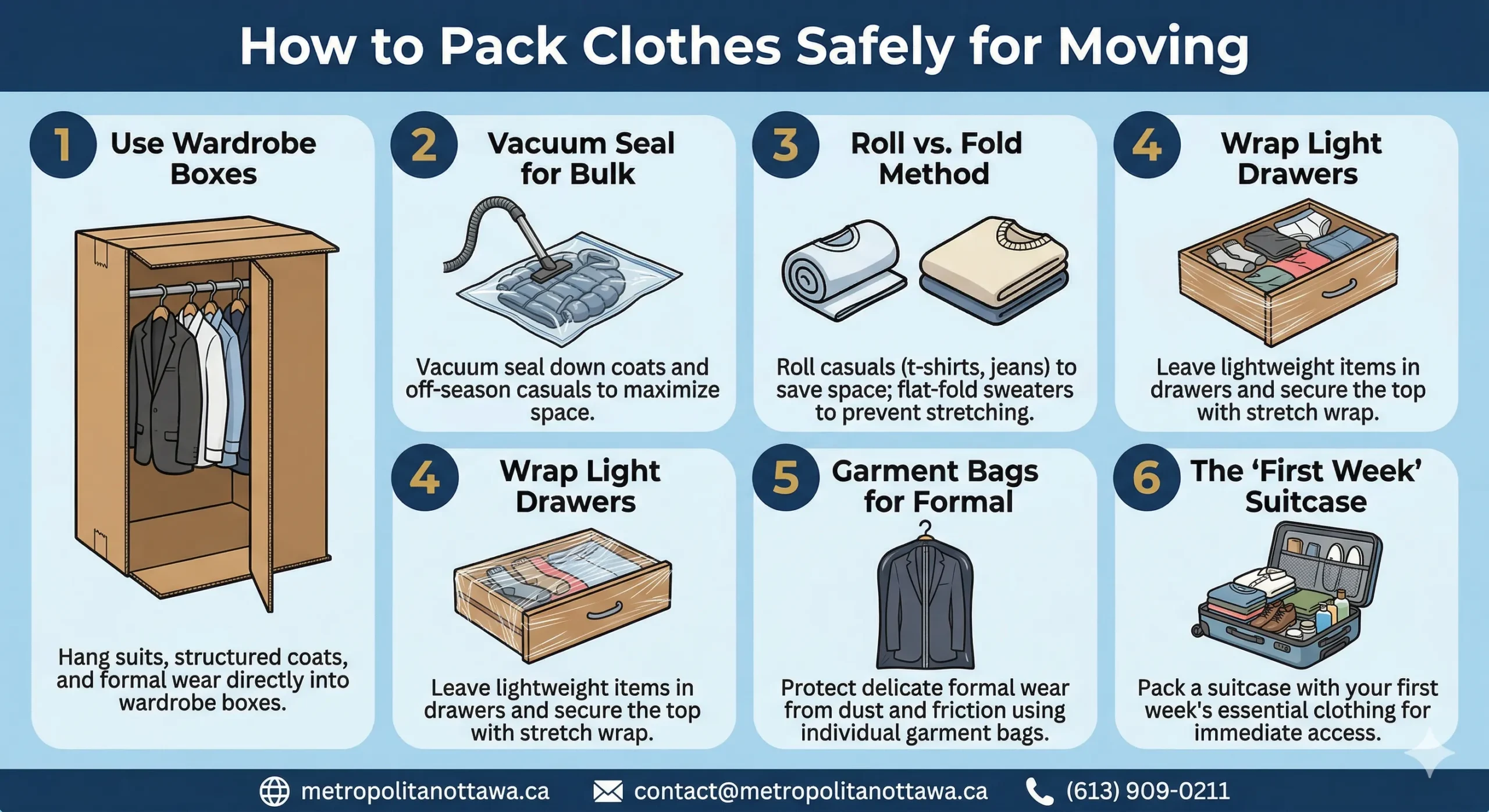
A wardrobe box is a tall, purpose-built moving carton measuring approximately 24″ x 20″ x 45–48″ with a built-in metal hanging bar across the top interior. Garments transfer directly from your closet rod onto the wardrobe box bar in a single motion, maintaining their hanger, their shape, and their organization throughout the entire move. At the destination, they transfer directly back onto the closet rod with equal simplicity. The entire process from closet to closet takes minutes per wardrobe box rather than the significant time required to fold, pack, transport, and re-hang the same garments.
The practical advantages of wardrobe boxes are substantial:
Suits, blazers, structured jackets, and coats maintain their shape entirely throughout transit without the compression damage that folding creates
Formal wear including dresses, dress shirts, and formal trousers arrives wrinkle-free or with minimal wrinkling that resolves without ironing
The hanging organization from your current closet transfers intact, making it easier to maintain organization categories through the move and into the new space
Delicate fabrics that are damaged by folding — silk blouses, chiffon dresses, structured knitwear — travel without any contact stress
Wardrobe box capacity: A standard wardrobe box holds approximately 24–30 garments on hangers, equivalent to roughly 2 feet of closet rail space. For a fully stocked wardrobe, plan for one wardrobe box per 2 feet of hanging clothing. Most households require between 2 and 6 wardrobe boxes depending on wardrobe volume.
What goes in a wardrobe box:
Suits and blazers — always wardrobe box, never folded
Formal dresses and evening wear — always wardrobe box
Structured coats and winter jackets — wardrobe box whenever box height accommodates the length
Dress shirts and blouses — wardrobe box for wrinkle-sensitive fabrics
Everyday shirts and casual garments on hangers — wardrobe box if space allows, folded boxes as alternative
Using the space below the hanging garments: The floor space inside a wardrobe box below the hanging garments can accommodate folded items, shoes in bags, or soft accessories — effectively converting unused space into additional packing capacity. Avoid placing anything heavy enough to damage the box floor or create an unstable base that swings the hanging garments.
Vacuum Seal Storage Bags: Maximum Compression for the Right Categories
Vacuum seal storage bags are one of the most space-efficient packing tools available for specific clothing categories — but they are also one of the most frequently misused, applied to garment types where compression causes permanent damage.
Where vacuum seal bags work correctly:
Vacuum bags are appropriate for clothing that is naturally compressible and recovers fully from compression — specifically:
Heavy winter coats and down jackets — down and synthetic insulation compresses dramatically and recovers fully when space allows. A coat that occupies an entire box in its natural state fits with two or three others in a single vacuum bag
Seasonal items in long-term storage — sweaters, heavy knitwear, and thermal layering pieces that will not be needed immediately after the move
Bed linens, blankets, and throws — not clothing specifically, but vacuum bags excel at compressing bulky bedding during moves
Casual t-shirts, jeans, and non-structured everyday items — these fabrics recover fully from compression and benefit from the space savings vacuum bags provide
Where vacuum seal bags cause damage:
Vacuum bags are not appropriate for structured garments where the specific shape is maintained by internal construction — padding, boning, interfacing, or tailoring. Compressing these items destroys the structure that makes them functional and wearable:
Suit jackets and blazers — the shoulder padding and chest canvas are permanently deformed by compression
Structured coats with interlining — same concern as suit jackets
Leather and faux leather garments — compression creates permanent creasing in non-fabric materials that dry cleaning cannot reverse
Embellished or beaded garments — the weight of compression can crack or dislodge decorative elements
Using vacuum bags correctly:
Fill the bag to its recommended capacity — overfilling prevents the valve from sealing properly. Use a vacuum cleaner nozzle for thorough air removal rather than relying on the roll-and-press manual method, which leaves more residual air. Seal the valve firmly before disconnecting the vacuum. Label each bag with contents before placing in a box — vacuum-sealed bags look identical from the outside regardless of what is inside.
| Clothing Category | Best Packing Method | Container Type | Key Consideration |
|---|---|---|---|
| Suits and blazers | Hang in wardrobe box | Wardrobe box | Never fold — compression destroys shoulder structure |
| Formal dresses and evening wear | Hang in garment bag + wardrobe box | Wardrobe box | Use garment bag for added protection on delicate fabrics |
| Down jackets and winter coats | Vacuum seal or wardrobe box | Vacuum bag or wardrobe box | Down recovers from compression; structured coats do not |
| Everyday t-shirts and jeans | Rolling method in boxes | Medium moving box | Rolling maximizes space, minimizes creasing |
| Sweaters and knitwear | Flat folding or vacuum seal | Moving box or vacuum bag | Fold flat — rolling can stretch knit structure |
| Delicate and silk garments | Lay flat with tissue paper between layers | Small moving box or garment bag | Acid-free tissue prevents color transfer and fabric stress |
| Casual seasonal clothing | Vacuum seal for off-season storage | Vacuum bag in labeled bin | Label clearly — off-season items should be last unpacked |
Rolling Clothes vs. Folding: Which Method Is Right for Your Move
The rolling versus folding debate is genuinely contextual — both methods are correct for specific garment types and packing situations. Understanding when each applies prevents the common mistake of applying a single method to an entire wardrobe regardless of fabric type.
When Rolling Is Superior
Rolling is the preferred method for packing clothes for a move when maximizing box space utilization and minimizing wrinkling are the primary goals. Rolling works best for:
T-shirts, casual shirts, and polo shirts — rolling reduces volume by approximately 30% compared to folding and creates far fewer crease lines
Jeans, chinos, and casual trousers — rolled jeans pack into corners and gaps that folded pairs cannot fill
Athletic wear and workout clothing — synthetic performance fabrics roll compactly and recover instantly from compression
Underwear and socks — rolling these items creates uniform cylinders that stack efficiently in box corners and gaps
Casual dresses and skirts — cotton and jersey casual garments roll without lasting crease damage
The correct rolling technique: Lay the garment flat on a clean surface. Fold in any protruding sleeves or straps. Starting from the bottom hem, roll tightly and evenly toward the collar or waistband. The resulting cylinder should be firm but not compressed to the point of fabric stress. Place rolled items in the box with the open end of the roll facing upward — this prevents unrolling during transit.
When Folding Is Superior
Folding is the preferred method for garment types where rolling risks distorting structure or creating visible crease lines in problematic locations:
Knitwear and sweaters — rolling can stretch knit structures, particularly around the collar and cuffs. Flat folding preserves the natural shape
Structured trousers and dress pants — folded along the existing crease maintains the press that rolling destroys
Formal shirts being packed rather than hung — folding along the button placket and shoulder seams preserves the collar and front panel
Denim jackets and structured casual jackets — folding along the seam lines prevents the compression ridge that rolling creates
The Hybrid Approach
The most efficient approach for most households is a deliberate hybrid — rolling casual, compressible garments to maximize space and folding structured, crease-sensitive items to preserve condition. Pack rolled items in the base of boxes and folded items in layers on top, where they receive less pressure from above.
Moving Dresser Drawers Intact: The Method That Saves Hours of Packing Time
One of the most practical time-saving strategies for packing clothes for a move is moving dresser drawers intact — with their contents still inside — rather than emptying them into boxes. This approach is appropriate in specific circumstances and completely wrong in others. Understanding the distinction prevents both wasted time and damaged furniture.
When moving drawers intact is appropriate:
Drawers containing lightweight clothing items — t-shirts, underwear, socks, folded casual wear
Drawers that are not overfilled — contents should sit well below the drawer top with no risk of spilling during handling
Dressers being transported in a moving truck rather than a portable moving container where vibration and shifting are more severe
Short-distance local moves within Ottawa, Kanata, or Nepean where transit time is brief
The correct method: Remove each drawer from the dresser body. Place a layer of stretch wrap or plastic wrap across the top of the drawer contents to prevent items from shifting or falling during handling. Wrap the entire drawer in plastic stretch wrap or large moving paper to keep the wrap in place and protect the drawer finish. Transport drawers separately from the dresser body and stack carefully in the moving truck.
When moving drawers intact is wrong:
Drawers containing heavy items — jeans, heavy knitwear, shoes — create dangerous weight when combined with the drawer itself
Drawers in antique or high-value dressers where stress on the drawer rails and joints risks structural damage
Long-distance moves where vibration and extended transit create settling that can cause drawer contents to shift and expand, making drawers difficult to replace in the dresser body
Any drawer that is already stiff or requires force to open and close — transit makes these problems worse
For long-distance moves to cities like Vancouver or Halifax, emptying all drawers and packing contents in boxes separately from the dresser is the safest approach. The how to pack for moving guide covers furniture preparation in detail alongside clothing and other household categories.
Garment Bags for Formal Wear: Protecting Your Most Valuable Clothing
Garment bags provide a layer of protection between formal wear and the wardrobe box environment that is particularly valuable for the clothing categories where condition matters most. Used correctly in combination with wardrobe boxes, garment bags are the gold standard for moving formal and high-value clothing.
What garment bags protect against:
Dust and particulate accumulation during the move and any interim storage period
Fabric-to-fabric contact that causes pilling on delicate surfaces and color transfer between garments
Minor moisture exposure during loading and unloading in variable weather
Snags from adjacent hangers and the metal wardrobe bar
Garment types that benefit from garment bags:
Wedding dresses and bridal party clothing — irreplaceable and extremely fabric-sensitive
Evening gowns and formal dresses with embellishments, beading, or sequins
Men’s suits, particularly if recently dry cleaned
Vintage and designer clothing where surface condition affects both appearance and value
Heavily embroidered or decorated ethnic formal wear
Leather garments that require protection from contact with other fabrics
Using garment bags correctly: Each garment should be in its own garment bag rather than sharing with other pieces — fabric-to-fabric contact through the bag is the primary thing you are trying to prevent. For very long garments like full-length evening gowns, fold the lower portion of the garment bag up and secure with a safety pin or elastic rather than leaving excess length dragging on the wardrobe box floor. Label each garment bag on the outside with a brief description — this prevents opening all bags to find a specific item during unpacking.
For particularly valuable formal wear including wedding dresses and designer pieces, the how to pack fragile items guide provides additional context on documenting and protecting high-value belongings before a move.
Packing Heavy Winter Coats: The Method That Preserves Loft and Structure
Winter coats represent a significant clothing investment and present specific packing challenges due to their bulk, their structural properties, and the damage that incorrect compression can cause.
For down and synthetic fill coats: Down and synthetic insulation is designed to compress and recover — it is the fundamental property that makes these materials effective as insulation. Vacuum seal bags are appropriate and space-efficient for down and lightweight synthetic fill coats. After unpacking, hang the coat in an open area for 24–48 hours to allow full loft recovery before wearing or storing.
For structured wool and heavy winter coats: Structured winter coats — particularly wool overcoats, duffle coats, and any coat with interlining, shoulder structure, or boning — should never be vacuum sealed. These coats belong in wardrobe boxes where they hang in their natural position throughout the move. If wardrobe box space is limited, fold wool coats carefully along their natural seam lines and wrap loosely in packing paper, placing them in the top layer of a box where they receive no compression from above.
For leather and faux leather coats: Leather and faux leather cannot be compressed without permanent creasing. These coats should hang in wardrobe boxes wherever possible. If boxing is necessary, fold minimally along the existing fold lines at the elbow and back, wrap in packing paper or a clean cotton sheet, and position in a box where nothing will press on them during transit.
Suitcase Packing Strategy: Using What You Already Have
Suitcases are one of the most underutilized packing containers in any household move — they are already designed for clothing transport, already wheeled for easy handling, and otherwise occupy truck space empty while boxes carry your wardrobe. Using suitcases strategically for clothing during a move both maximizes their utility and reduces the number of boxes required.
The correct suitcase packing hierarchy:
Pack suitcases last — suitcases should contain the clothing you will need during the first 3–5 days at your new home before boxes are unpacked. This includes work clothing for the first week, essential casual wear, pajamas, and underwear and socks for the transit period. Treating your suitcase as a “first week survival kit” ensures that essential items are immediately accessible without opening any moving boxes.
Use existing luggage for heavy items — hard-shell suitcases with wheels handle dense clothing like jeans and heavy knitwear more easily than cardboard boxes that require carrying. Position these heavier suitcases where they can be wheeled rather than lifted.
Pack soft-sided bags for bulky but light items — large duffel bags and soft luggage handle bulky items like towels, throw blankets, and pillows more efficiently than boxes.
Layer thoughtfully within suitcases:
Shoes in the bottom and corners — use shoe bags or wrap individual shoes in packing paper to prevent sole contact with clothing
Rolled casual clothing packed around shoes
Folded structured items in the top layer
Delicate items wrapped in packing paper or placed in the center surrounded by softer items
Labeling Seasonal Clothing Bins: The Organization System That Makes Unpacking Effortless
Labeling clothing containers with the level of detail that actually matters during unpacking is one of the highest-value preparation steps in the entire clothing packing process — and one that most movers give the least attention.
A box labeled simply CLOTHES tells you nothing useful when you are standing in front of a stack of identical boxes at the new home. A box labeled MASTER BEDROOM — WINTER SWEATERS — UNPACK WEEK 2 tells you exactly what is inside, where it belongs, and how urgently it needs to be opened.
The effective labeling system for clothing:
Each clothing container — whether a box, bin, vacuum bag, or suitcase — should be labeled with:
Destination room — MASTER BEDROOM, KIDS ROOM, GUEST ROOM
Owner — especially in multi-person households where clothing overlaps between rooms
Category or season — WINTER COATS, SUMMER DRESSES, WORK CLOTHING, CASUAL
Priority — UNPACK FIRST (essential first week), UNPACK WEEK 1 (everyday use), UNPACK WEEK 2+ (seasonal or rarely used)
This four-element labeling system — room, owner, category, priority — allows you to identify and sequence your unpacking without opening a single box to determine its contents. It also allows anyone helping you unpack — family members, friends, or professional movers providing packing and unpacking services — to place boxes correctly and prioritize opening them without requiring your direction for every individual item.
For the complete unpacking framework that pairs with this organizational approach, the how to unpack after moving guide provides the most thorough resource available for Ottawa residents managing the post-move settling process. The settling after moving guide covers the broader context of getting comfortable in a new home during the first weeks after arrival.
| Label Element | Example | Why It Matters |
|---|---|---|
| Destination room | MASTER BEDROOM | Movers place box in correct room without asking |
| Owner | SARAH | Prevents mixed unpacking in multi-person households |
| Category or season | WINTER SWEATERS | Identifies contents without opening the box |
| Unpack priority | UNPACK WEEK 2+ | Allows efficient sequencing — essentials first |
| Special handling | DELICATE — DO NOT STACK | Protects formal wear and delicate fabrics in transit |
The Complete Clothing Packing Timeline: When to Pack What
Clothing packing is most efficient when approached in a specific sequence that ensures essential items remain accessible throughout the move while non-essential items are packed early to reduce the packing workload during the final days.
4–6 weeks before moving day: Seasonal clothing not currently in use — off-season coats, summer clothing in winter or winter clothing in summer — can be packed immediately. These items will not be needed before the move and benefit from early packing in labeled, organized bins or vacuum bags.
2–3 weeks before moving day: Formal wear, occasion-specific clothing worn rarely, and any wardrobe category you have not needed in the past month. Pack these into wardrobe boxes or garment bags with careful labeling.
1 week before moving day: Everyday clothing not needed for the final week — the majority of your casual wardrobe beyond what you will actually wear in the next 7 days.
2–3 days before moving day: Pack the final week’s wardrobe, leaving only the clothing you will wear until moving day morning. This small remaining set goes into your suitcase as the first-week survival kit.
Moving day morning: The clothing worn on moving day goes into the suitcase last, after everything else is loaded. This suitcase travels with you personally rather than in the moving truck whenever possible — ensuring access to essential clothing regardless of truck arrival timing.
For the complete day-of logistics framework, the moving day guide provides a comprehensive timeline that integrates clothing packing with every other moving day task.
Common Clothing Packing Mistakes and How to Avoid Every One
| Common Mistake | Why It Causes Problems | The Correct Approach |
|---|---|---|
| Using garbage bags for clothing | Bags tear, offer no structure, allow moisture entry | Use wardrobe boxes, moving boxes, or vacuum bags |
| Vacuum sealing structured garments | Permanently destroys shoulder pads, jacket shape | Only vacuum seal compressible, unstructured items |
| Folding all items including casual wear | Creates unnecessary crease lines, wastes box space | Roll casual items, fold structured garments |
| Moving heavy drawers intact | Creates dangerous weight, stresses drawer joints | Empty heavy drawers — move lightweight items only intact |
| No labeling beyond “CLOTHES” | Makes unpacking a disorganized sorting exercise | Label with room, owner, category, and priority |
| Packing essential first-week clothing in boxes | Basic daily needs buried and inaccessible | Pack first-week clothing in an accessible suitcase |
| Skipping garment bags for formal wear | Dust, fabric contact, and minor moisture damage | Use individual garment bags for all formal clothing |
| Packing damp or unwashed clothing | Creates mildew in sealed boxes during transit | Ensure all clothing is clean and fully dry before packing |
Packing Clothes for Long-Distance Moves: What Changes Over Distance
Packing clothes for a local move within Orleans or Gatineau differs meaningfully from packing for a long-distance move to Edmonton, Calgary, or Saskatoon. Extended transit time introduces considerations that short-distance moves do not require.
Extended wardrobe box protection: For long-distance moves, wardrobe boxes should have their open tops covered with a plastic bag or sealed loosely with packing paper to prevent dust accumulation during multi-day transit. Garment bags become more important rather than optional for formal wear when transit time extends beyond 24 hours.
Moisture management: Include moisture-absorbing sachets inside clothing boxes — particularly those containing natural fiber garments like wool, cotton, and linen that are susceptible to humidity absorption during extended transit. Cedar blocks inside wardrobe boxes provide natural moisture management alongside their traditional deterrent function.
Vacuum bag reinforcement: Ensure vacuum bag seals are tested for integrity before the box is sealed. A vacuum bag that loses its seal mid-transit expands unpredictably and can create pressure against other box contents. Double-seal vacuum bags for long-distance moves by checking the valve and adding a strip of tape across it.
The long-distance moving guide covers the full preparation framework for moves where distance introduces complexity beyond standard local move planning.
Frequently Asked Questions
What is the best way to pack hanging clothes for a move?
Wardrobe boxes with built-in hanging bars are the best solution for hanging clothes. Garments transfer directly from your closet rod to the wardrobe bar in seconds, maintaining their hanger, shape, and organization throughout the entire move. For formal wear and delicate garments, adding an individual garment bag before placing it in the wardrobe box provides additional protection against dust, fabric contact, and minor moisture exposure.
Should I roll or fold clothes when packing for a move?
Roll casual, compressible garments — t-shirts, jeans, athletic wear, casual dresses — to maximize box space and minimize creasing. Fold structured garments — sweaters, dress pants, formal shirts not going in a wardrobe box — flat along their natural seam lines to preserve shape. The hybrid approach, rolling casual items and folding structured ones, is the most efficient method for most households.
Can I move dresser drawers with clothes still inside?
Yes, for lightweight clothing items — t-shirts, underwear, socks — in drawers that are not overfilled. Wrap the top of the drawer in plastic stretch wrap to prevent items from shifting, then transport drawers separately from the dresser body. Never move drawers intact when they contain heavy items like jeans, shoes, or heavy knitwear, or when the dresser is antique or high-value.
Are vacuum seal bags safe for all clothing types?
No. Vacuum bags are safe for down jackets, casual unstructured garments, sweaters, and seasonal items. They permanently damage structured garments — suit jackets, blazers, structured coats, and leather items — by destroying the padding, interfacing, and shape that tailoring creates. Never vacuum seal anything that you would typically hang rather than fold in your daily closet routine.
Does Metropolitan Movers Ottawa help with packing clothes for a move?
Yes. Metropolitan Movers Ottawa provides comprehensive packing and unpacking services for clothing and entire households. The team brings wardrobe boxes, garment bags, packing paper, and all necessary materials to pack your wardrobe correctly — protecting everything from everyday casual wear to formal clothing and rare vintage pieces. With over 15 years of experience, the team handles clothing packing efficiently and correctly on every job.
Your Wardrobe Deserves the Same Care You Gave It When You Built It —
Packing clothes for a move is one of the most practical and process-driven tasks in any relocation — one where the right method for each garment type produces a dramatically better outcome than a one-size-fits-all approach. Wardrobe boxes for hanging garments. Vacuum seal bags for compressible winter coats. Rolling for casual wear and folding for structured pieces. Garment bags for formal clothing. Intact drawers for lightweight contents. Suitcases for the first week’s essentials. A labeling system that makes unpacking efficient rather than chaotic. When these methods are applied deliberately and consistently, your entire wardrobe arrives organized, undamaged, and ready to fill your new closet without a single morning of frustration searching for something to wear. Metropolitan Movers Ottawa brings 15+ years of experience to every relocation — from local moves within Ottawa and Kanata to long-distance moves across Canada. Whether you need professional packing support, a full residential move, or simply guidance on the best approach for your specific wardrobe, reach out today and move forward with complete confidence.