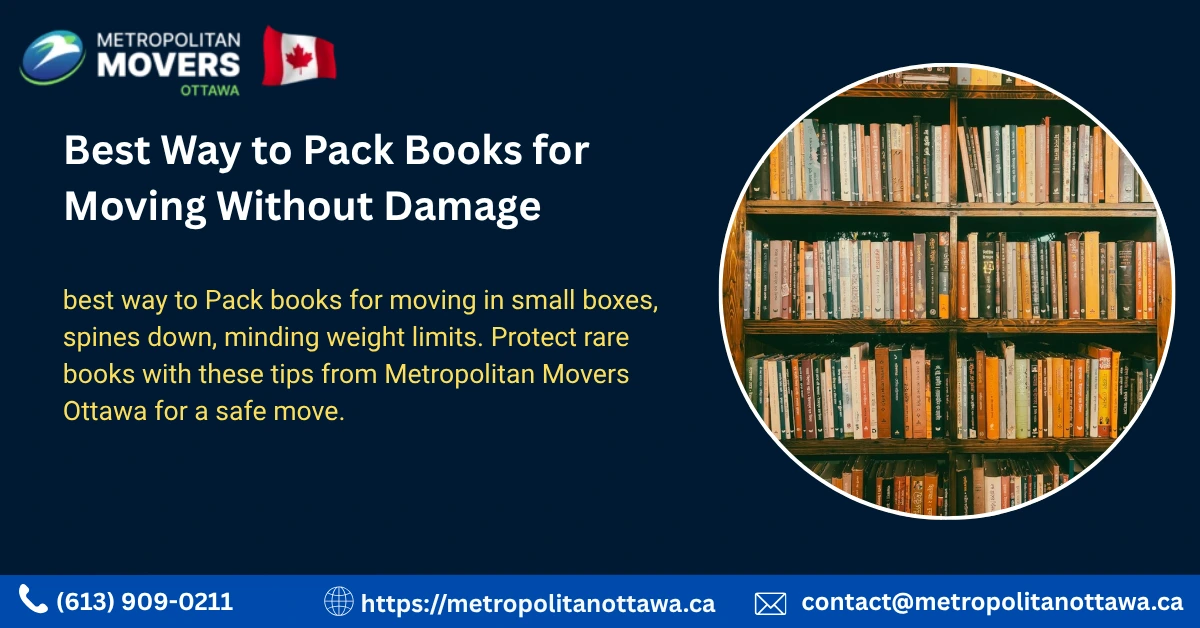
Books are among the heaviest items in any household per cubic foot — and that simple physical reality makes them one of the most frequently mishandled categories during a move. Overpacked boxes split at the seams. Spines crack when books are positioned incorrectly. Rare editions suffer moisture damage that no amount of insurance can reverse. Learning the best way to pack books for moving protects both your collection and the people who will be lifting those boxes on moving day. Whether you are relocating a modest shelf of paperbacks or a substantial home library that has taken decades to build, the techniques in this guide apply equally. For the broader framework of packing an entire household correctly, the complete packing guide for moving is the most comprehensive resource available for Ottawa residents preparing for any size relocation.
Why Book Packing Goes Wrong and What Actually Prevents Damage
Before packing a single volume, understanding why books get damaged during moves helps focus your effort on the failure points that actually matter. Most book damage is entirely preventable — it results from specific, identifiable errors that first-time movers repeat because they have never been taught the correct approach.
The four primary causes of book damage during moves are:
- Overweight boxes — books packed in large boxes exceed safe lifting weight, causing box failure during handling, back injuries to movers, and dropped boxes that damage contents
- Incorrect spine positioning — books packed with spines facing upward allow the text block to sag away from the spine under gravity, loosening bindings and damaging the structural integrity of hardcovers
- Moisture exposure — books absorb humidity during transit and storage, causing warping, foxing, and mold growth that is often irreversible
- Compression damage — books packed too tightly or under excessive stacking weight suffer cracked spines, bent covers, and permanent deformation
Every decision made when packing books should target these four failure points specifically. The best way to pack books for moving is the method that addresses all four simultaneously — and that method is what this guide teaches. For a complete overview of packing supplies you need for a full household pack, that guide covers materials across every category of belongings.
Small Heavy-Duty Moving Boxes: The Non-Negotiable Foundation
The single most important rule for packing books is also the simplest: use small boxes, not large ones.
This rule exists because of weight, not fragility. A standard book weighs between 0.5 and 2 pounds depending on format and page count. A large moving box measuring 18″ x 18″ x 24″ can hold approximately 60–80 paperbacks or 30–40 hardcovers — resulting in a packed weight of 70–100+ pounds. That weight exceeds safe manual lifting thresholds, causes box bottoms to fail during transport, and creates dangerous handling conditions for anyone involved in the move.
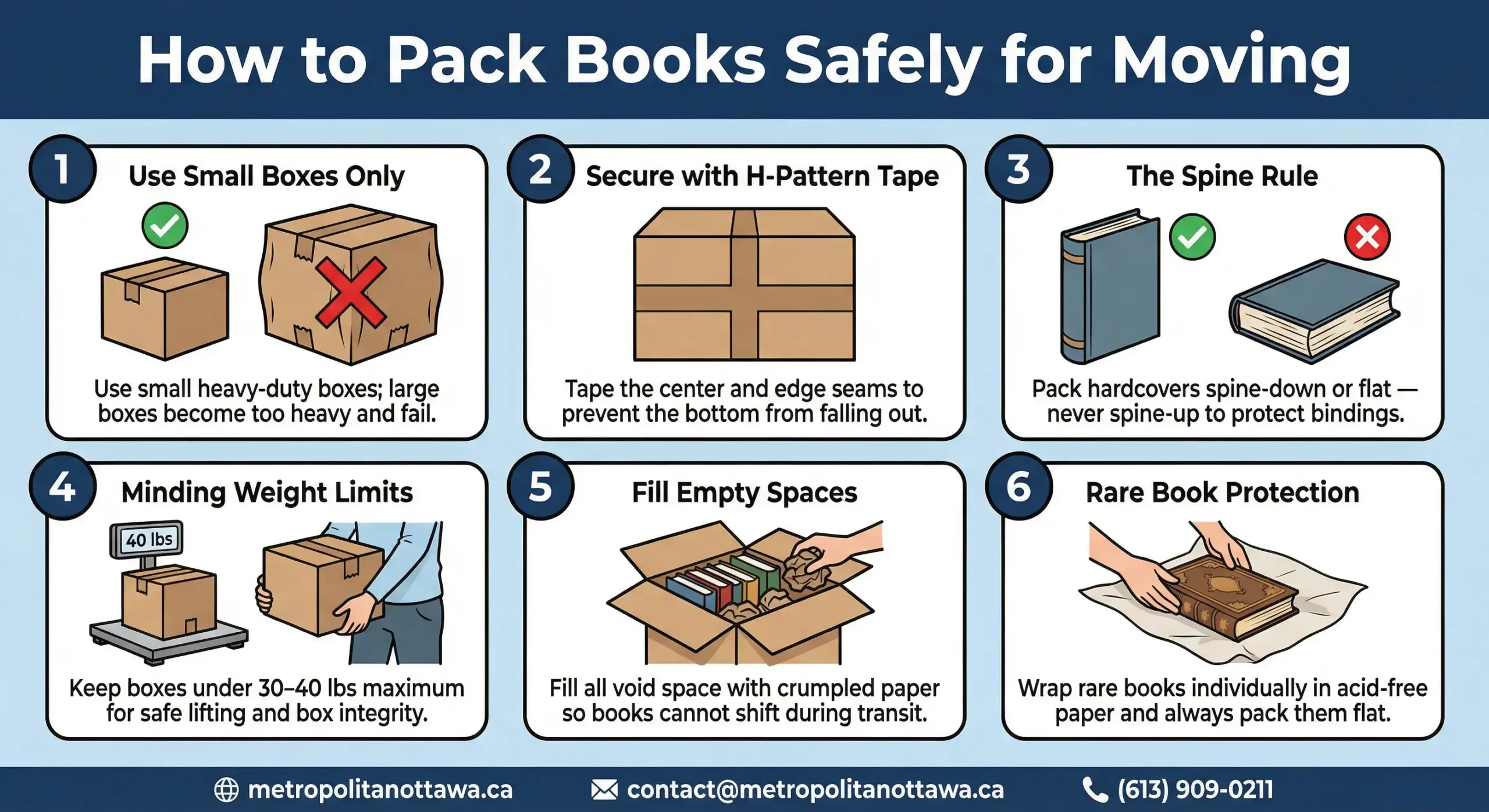
Small heavy-duty moving boxes measuring approximately 12″ x 12″ x 16″ or 1.5 cubic feet are the correct container for books. These boxes hold approximately 20–30 paperbacks or 15–20 hardcovers, producing a packed weight of approximately 30–40 pounds — well within safe lifting range and manageable for box structural integrity.
The “heavy-duty” designation matters. Standard single-wall cardboard boxes are engineered for light to medium contents. Heavy-duty boxes feature thicker corrugated walls, reinforced flaps, and structural integrity designed to handle dense contents like books without bottom blowout or corner failure. The modest additional cost per box is one of the most cost-effective damage prevention investments in the entire packing process.
For households with substantial book collections requiring many boxes, the packing checklist for moving helps ensure adequate supplies are assembled before packing begins.
Understanding Book Weight Limits: How Heavy Is Too Heavy
The weight limit for book boxes is not arbitrary — it reflects both human ergonomic safety and cardboard structural engineering. Understanding these limits prevents the most common book packing failures.
For manual lifting safety: The generally accepted safe lifting limit for a single person handling boxes repeatedly is 40–50 pounds maximum. Professional movers routinely handle boxes in this range throughout a full moving day. Boxes exceeding 50 pounds create fatigue-related injury risk, require two-person lifts that slow the moving process, and are more likely to be dropped during handling transitions.
For box structural integrity: Small heavy-duty moving boxes are engineered to support approximately 65–80 pounds of static weight without failure. However, the dynamic forces during lifting, carrying, and stacking significantly exceed static weight — meaning a 70-pound box that sits safely on a floor may fail when lifted by its handholds or when another box is stacked on top of it during truck loading.
The practical rule: Pack book boxes to approximately 30–40 pounds maximum. Test each box by lifting it before sealing. If it feels uncomfortably heavy or causes strain, remove books until the weight feels manageable. When in doubt, err toward lighter boxes — no one has ever complained that moving boxes were too easy to lift.
| Box Size | Dimensions (Approx.) | Book Capacity | Typical Packed Weight | Recommendation |
|---|---|---|---|---|
| Small (Book Box) | 12″ x 12″ x 16″ | 20–30 paperbacks or 15–20 hardcovers | 30–40 lbs | Ideal — use for all books |
| Medium | 18″ x 18″ x 16″ | 40–50 paperbacks or 25–30 hardcovers | 50–70 lbs | Too heavy — avoid for books |
| Large | 18″ x 18″ x 24″ | 60–80 paperbacks or 30–40 hardcovers | 70–100+ lbs | Dangerous — never use for books |
| Wardrobe Box | 24″ x 24″ x 40″ | N/A | N/A | Not designed for books |
Packing Books Spine Up vs. Flat vs. Upright: Which Position Is Correct
The positioning of books within boxes is one of the most debated topics in moving advice — and much of the conventional wisdom is either incomplete or simply wrong. Understanding the structural mechanics of book binding clarifies which position protects different book types most effectively.
Hardcover Books: Pack Spine Down or Flat
Hardcover books should never be packed with the spine facing upward. When a hardcover stands spine-up, gravity pulls the text block — the pages glued or sewn into the binding — downward and away from the spine. Over the hours or days of a move, this gravitational stress loosens the binding adhesive, creates gaps between the text block and the spine, and can permanently damage the book’s structural integrity.
Correct hardcover positioning:
- Spine down (upright position) — books standing vertically with spines resting on the box bottom. This allows gravity to press the text block into the spine rather than pulling it away.
- Flat (horizontal stacking) — books lying flat with covers facing up or down, stacked in layers. This distributes weight evenly across the entire cover surface.
Both positions are acceptable for hardcovers. Spine-down positioning is generally preferred because it maximizes box capacity while maintaining proper binding support. Flat stacking works well for oversized hardcovers that do not fit neatly in upright position.
Paperback Books: More Flexibility, Same Principles
Paperback bindings are more flexible than hardcovers and tolerate a wider range of positions without structural damage. However, the same general principle applies — avoid positioning that allows the text block to sag away from the spine under gravity.
Acceptable paperback positioning:
- Spine down (upright) — preferred for standard paperbacks
- Flat (horizontal stacking) — acceptable for all paperback sizes
- Spine to the side (horizontal upright) — acceptable for paperbacks packed snugly enough that lateral movement is prevented
Rare and Valuable Books: Always Pack Flat
For rare books, first editions, antique volumes, and any book whose condition affects its value, flat horizontal packing is the only appropriate method. Flat positioning distributes weight evenly, eliminates gravitational stress on bindings, and protects covers and corners from the compression that upright packing can create if books shift during transit.
Securing Box Bottoms with Tape: The Step That Prevents Catastrophe
A book box that fails at the bottom drops 30–40 pounds of dense contents onto whatever surface — or body part — happens to be below it. Box bottom failure is the most dramatic and preventable form of damage in book moving, and it results almost entirely from inadequate taping.
The correct bottom-taping sequence:
- Fold the box bottom flaps into their interlocking position
- Apply one strip of packing tape along the center seam running the full length of the box bottom
- Apply one strip along each edge where the folded flaps meet the box sides — these edge seams are where bottom blowout typically initiates
- Extend tape approximately 3 inches up each side of the box to anchor the bottom reinforcement to the box walls
This H-pattern taping — center strip plus edge strips — provides structural reinforcement that distributes weight across the entire bottom surface rather than concentrating stress on the center seam alone. For boxes being used for books specifically, doubling the center seam tape provides additional security worth the minimal extra time investment.
The same H-pattern should be applied to box tops after packing is complete, ensuring structural integrity during stacking and handling throughout the move.
Acid-Free Packing Paper: When It Matters and When It Does Not
Acid-free packing paper is a specialized material designed to prevent the chemical degradation that standard paper can cause when in prolonged contact with book covers, dust jackets, and pages. Understanding when acid-free materials are necessary — and when standard packing paper is adequate — helps allocate your packing budget effectively.
When acid-free paper is essential:
- Rare books, first editions, and collectible volumes where condition affects value
- Antique books with leather bindings or gilt edges susceptible to chemical damage
- Books with original dust jackets that are irreplaceable or valuable in their own right
- Any book being placed in long-term storage rather than unpacked immediately after a move
When standard packing paper is adequate:
- Everyday reading copies with no particular collectible value
- Modern paperbacks in regular circulation
- Books that will be unpacked and shelved within days of arrival at the new home
- Replaceable editions where cosmetic condition is not a priority
For rare book collections being moved long distance to cities like Vancouver or Calgary where extended transit time increases exposure risk, acid-free tissue paper interleaved between books and wrapping dust jackets provides meaningful protection that justifies the additional material cost.
Step-by-Step Book Packing: The Complete Method
Bringing together all the techniques covered above, this is the complete sequence for packing books using the best way to pack books for moving:
Step 1: Prepare the box Tape the bottom of a small heavy-duty moving box using the H-pattern — center seam plus both edge seams, with tape extending up the sides.
Step 2: Create a cushion base Line the box bottom with a layer of packing paper to prevent books from contacting cardboard directly. For valuable books, use acid-free tissue paper.
Step 3: Position hardcovers spine-down Place hardcover books standing upright with spines resting on the box bottom. Pack tightly enough that books support each other without being compressed.
Step 4: Fill gaps with paperbacks or packing paper Use smaller paperbacks to fill gaps between hardcovers. Where gaps remain, fill with crumpled packing paper to prevent shifting during transit.
Step 5: Add flat layers if space remains If vertical packing leaves unused height in the box, add a flat layer of books on top of the upright layer. Place packing paper between layers to prevent cover scuffing.
Step 6: Fill remaining void space Add crumpled packing paper on top until the box is full and contents cannot shift when the box is gently shaken.
Step 7: Test weight before sealing Lift the box by its handholds. If it feels uncomfortably heavy or strains your back, remove books until the weight feels manageable. Target 30–40 pounds maximum.
Step 8: Seal and label Tape the top using the same H-pattern as the bottom. Label the box with contents (BOOKS — LIVING ROOM or BOOKS — OFFICE) and add HEAVY warning on all sides.
Protecting Rare Book Collections: Premium Handling for Premium Value
Rare books, first editions, signed copies, and antique volumes require handling protocols that exceed what everyday reading copies need. The investment you have made in building a rare book collection deserves protection proportional to its value — both monetary and personal.
Individual wrapping for valuable books: Each valuable book should be wrapped individually in acid-free tissue paper before placement in the box. For books with original dust jackets, wrap the jacket separately from the book itself, or secure the jacket with a protective mylar cover before wrapping the entire package.
Climate control considerations: Books are hygroscopic — they absorb and release moisture from surrounding air. Extended exposure to high humidity causes warping, foxing, and mold. Extended exposure to low humidity causes paper brittleness and leather cracking. For rare books in long-distance moves where transit time extends to multiple days, discuss climate-controlled transport options with your moving company.
Custom crating for exceptional pieces: For books of extraordinary value — rare antiquarian volumes, original manuscripts, or irreplaceable family documents — custom crating provides the highest protection available. Custom crates are built to exact dimensions, lined with acid-free materials, and constructed to eliminate movement entirely during transit.
Insurance documentation: Before packing rare books, photograph each volume including spine, covers, and any notable condition features. Retain these images alongside professional appraisals if available. This documentation supports insurance claims in the event of damage and establishes condition baselines for valuable pieces. The moving cost guide for Canada provides context on valuation and coverage considerations for high-value items.
Organizing Your Home Library by Category Before Packing
The unpacking experience is significantly smoother when books are packed with organizational logic that translates directly to shelving at the new home. Taking time during packing to group books by category, room destination, or shelving location transforms unpacking from a chaotic sorting exercise into a straightforward placement task.
Effective organizational approaches:
By room destination: Pack all books destined for the home office together, all books for the living room together, all children’s books together. Label each box with its destination room. This approach minimizes box movement between rooms during unpacking.
By category or genre: For substantial libraries, packing by category — fiction, non-fiction, reference, cookbooks, children’s books — allows you to unpack and shelve one category at a time rather than mixing genres across boxes.
By shelving sequence: If your current library is organized in a specific order that you intend to replicate at the new home, pack books in the reverse of that order so the first box unpacked contains the books that belong at the end of your shelving sequence, and the last box unpacked contains books for the beginning.
By frequency of use: Pack rarely-used books first and frequently-used books last. This natural packing sequence ensures that essential references, current reads, and children’s bedtime books are accessible immediately upon arrival rather than buried in the first boxes packed weeks before moving day.
| Organization Method | Best For | Labeling Approach | Unpacking Benefit |
|---|---|---|---|
| By room destination | Multi-room libraries, family homes | BOOKS — OFFICE, BOOKS — KIDS ROOM | Minimizes inter-room box movement |
| By category or genre | Large collections, dedicated libraries | BOOKS — FICTION, BOOKS — REFERENCE | Allows category-by-category shelving |
| By shelving sequence | Organized collectors, specific systems | BOOKS — SHELF A1, BOOKS — SHELF B3 | Recreates existing organization exactly |
| By frequency of use | Practical prioritization | BOOKS — UNPACK FIRST, BOOKS — STORAGE | Essential books accessible immediately |
The how to unpack after moving guide provides the complete framework for efficient unpacking once you arrive at your new home.
Common Book Packing Mistakes and How to Avoid Every One
| Common Mistake | Why It Causes Problems | The Correct Approach |
|---|---|---|
| Using large boxes for books | Creates dangerously heavy boxes that fail during handling | Use small heavy-duty boxes only — 30–40 lbs maximum |
| Packing hardcovers spine-up | Gravity pulls text block away from spine, damaging binding | Pack hardcovers spine-down or flat |
| Single-strip bottom taping | Center seam fails under book weight during lifting | Use H-pattern taping — center plus both edge seams |
| Leaving void space in boxes | Books shift and collide during transit, damaging covers | Fill all gaps with packing paper or smaller books |
| Overpacking beyond weight limit | Creates lifting injuries and box structural failure | Test lift each box — remove books if too heavy |
| No labeling or generic labeling | Boxes get placed in wrong rooms, require re-sorting | Label with contents and destination room |
| Packing rare books with everyday copies | Valuable items lack necessary protection | Pack rare books separately with acid-free materials |
Packing Books for Long-Distance and Storage Moves
A local move within Ottawa, Kanata, or Gatineau involves relatively short transit time and immediate unpacking at the destination. A long-distance move to Halifax, Edmonton, or Saskatoon — or any move that includes a period of storage before unpacking — introduces additional considerations that short-distance moves do not require.
Extended transit protection:
- Use acid-free materials for any books of value, not just rare collectibles
- Double-tape all box seams using the H-pattern on both top and bottom
- Add an extra layer of packing paper on top of book contents to absorb any moisture that might enter through minor box gaps
- Consider wrapping completed boxes in plastic stretch wrap to create an additional moisture barrier
Storage-specific considerations:
- Never store book boxes directly on concrete floors — place on pallets or shelving to prevent moisture wicking from the floor into box bottoms
- Choose climate-controlled storage whenever possible to prevent humidity damage
- Position boxes so labels face outward for easy identification if specific boxes need to be accessed during storage
- Avoid stacking book boxes more than three high to prevent compression damage to bottom boxes over extended periods
The storage moving service offered by Metropolitan Movers Ottawa coordinates storage logistics for moves that require temporary holding periods between origin and destination.
When Professional Packing Is the Right Choice for Book Collections
The best way to pack books for moving is well within the capability of any household willing to invest the time and follow correct technique. However, certain circumstances make professional packing and unpacking services the more practical choice:
- Substantial library volume — homes with 500+ books face packing time requirements measured in full days rather than hours
- Rare or valuable collections where professional handling provides liability coverage that DIY packing cannot
- Time-compressed moves where packing days are limited and book packing competes with other essential preparation tasks
- Senior relocations where the physical demands of lifting and packing multiple heavy boxes present genuine difficulty
- Combined household moves where book packing is one element of a larger move that benefits from professional coordination throughout
Metropolitan Movers Ottawa brings over 15 years of experience to book packing and household moves of every scale. The team understands the weight considerations, positioning requirements, and protection protocols that book collections demand — and applies them consistently across every job. The complete packing guide for moving outlines the full scope of professional packing services available for Ottawa residents.
Frequently Asked Questions
What is the best way to pack books for moving?
The best way to pack books for moving is using small heavy-duty boxes with H-pattern tape reinforcement on the bottom, positioning hardcovers spine-down or flat, filling all void space with packing paper, and keeping total box weight under 40 pounds. Never use large boxes for books — the weight creates dangerous handling conditions and causes box failure.
Should books be packed flat or upright?
Hardcover books should be packed spine-down (upright with spines resting on the box bottom) or flat. Never pack hardcovers spine-up, as gravity will pull the text block away from the spine and damage the binding. Paperbacks are more flexible but follow the same general principle — avoid positions that stress the spine.
How heavy should a box of books be?
Book boxes should weigh 30–40 pounds maximum. This weight is safe for repeated manual lifting, maintains box structural integrity, and prevents the bottom blowout that commonly occurs with overpacked book boxes. Always test-lift a box before sealing — if it feels uncomfortably heavy, remove books until the weight is manageable.
Do I need special packing materials for rare books?
Yes. Rare books, first editions, and valuable volumes should be individually wrapped in acid-free tissue paper, packed flat rather than upright, and kept separate from everyday books. For exceptionally valuable pieces, custom crating and climate-controlled transport provide the highest protection. Photograph all rare books before packing for insurance documentation.
Does Metropolitan Movers Ottawa provide professional book packing services?
Yes. Metropolitan Movers Ottawa provides comprehensive packing and unpacking services for book collections and entire households. The team uses appropriate box sizes, correct positioning techniques, and proper reinforcement methods that protect books throughout the move. With over 15 years of experience, the team handles everything from modest reading collections to substantial home libraries requiring dozens of boxes.
Your Book Collection Deserves the Same Care It Took to Build
The best way to pack books for moving comes down to respecting the physical realities of what books are — dense, heavy, and structurally vulnerable in specific ways that correct technique prevents and incorrect technique damages. Small boxes. Spine-down or flat positioning. H-pattern tape reinforcement. Weight under 40 pounds. Acid-free materials for valuable pieces. Every technique in this guide exists because it prevents specific, predictable failures that destroy books during moves every day. Whether you are packing your own library using these methods or choosing professional packing services to ensure the job is done to the highest standard, the outcome you deserve is the same — opening boxes at your new home and shelving every book exactly as you remember it. Metropolitan Movers Ottawa brings 15+ years of experience to every move, from local relocations within Nepean and Orleans to long-distance moves across Canada. When you are ready, reach out today and move your library with complete confidence.