Jewelry is the category of household belongings that most consistently falls into the gap between careful packing and careless afterthought. Dishes get wrapped individually. Books get their own boxes. But jewelry — often representing the highest concentration of monetary and sentimental value per square inch in any home — frequently ends up bundled into a zip-lock bag, dropped into a makeup pouch, or thrown loosely into a shoebox with no system and no protection. The result is tangled necklace chains that take hours to separate, scratched gemstone settings, lost earring backs, and the particular distress of discovering that something irreplaceable arrived damaged or missing. The safest way to pack jewelry for moving requires a deliberate, category-by-category approach that matches each jewelry type to the right container and protection method. This guide covers every technique from threading chains through drinking straws to keeping high-value pieces with you personally throughout the move. For the complete household packing framework that situates jewelry packing within a full relocation plan, the complete packing guide for moving is the most comprehensive resource available for Ottawa residents preparing for any size relocation.
Why Jewelry Requires a Category of Its Own in Any Moving Plan
Jewelry damage during moves falls into four distinct categories that correct packing prevents entirely:
- Tangling damage — chains and delicate necklaces that are not individually contained become hopelessly knotted during transit. The combination of vibration, temperature changes, and box movement creates tangle patterns that can take hours to resolve and, for very fine chains, result in links that are permanently bent or broken during the untangling process
- Impact and scratch damage — gemstones scratch each other. Metal settings scratch metal surfaces. Pearls are scratched by virtually everything they contact. Any jewelry packed without individual containment will exit the box with surface damage that was not present at origin
- Loss of small components — earring backs, ring settings, pendant bails, and small charms separate from their pieces during transit and are lost in the packing material. Something as small as a diamond stud backing is genuinely impossible to find once it has fallen free in a moving box
- Moisture and tarnish — silver and certain other metals tarnish rapidly when exposed to humidity during extended transit or storage. Jewelry packed in non-breathable containers without anti-tarnish materials can develop significant tarnish during a move that requires professional cleaning to address
Understanding these four failure categories before packing a single piece focuses the entire process on the preventive measures that actually matter. For a complete overview of packing supplies you need for a full household pack, that guide covers materials across every category including the specialty items that jewelry packing requires.
The Essential Materials for Packing Jewelry Safely
Having the correct materials assembled before jewelry packing begins prevents the improvisation that leads to tangling, scratching, and loss. The materials for jewelry packing are more specialized than those for other household categories — but they are readily available and modest in cost relative to the value they protect.
Anti-tarnish pouches and cloth — silica-containing cloth that prevents tarnish formation on silver and silver-plated jewelry during transit and storage. Essential for any silver piece being packed for more than a few days.
Small zip-lock bags in multiple sizes — the foundation of individual piece containment. Small zip-lock bags isolate pieces from each other, prevent small components from separating, and allow visual identification without opening. Use jewelry-size bags rather than sandwich bags — the size difference matters for delicate pieces.
Acid-free tissue paper — appropriate for wrapping individual pieces before placing in bags or compartmented containers. Prevents metal-to-metal contact and protects surface finishes.
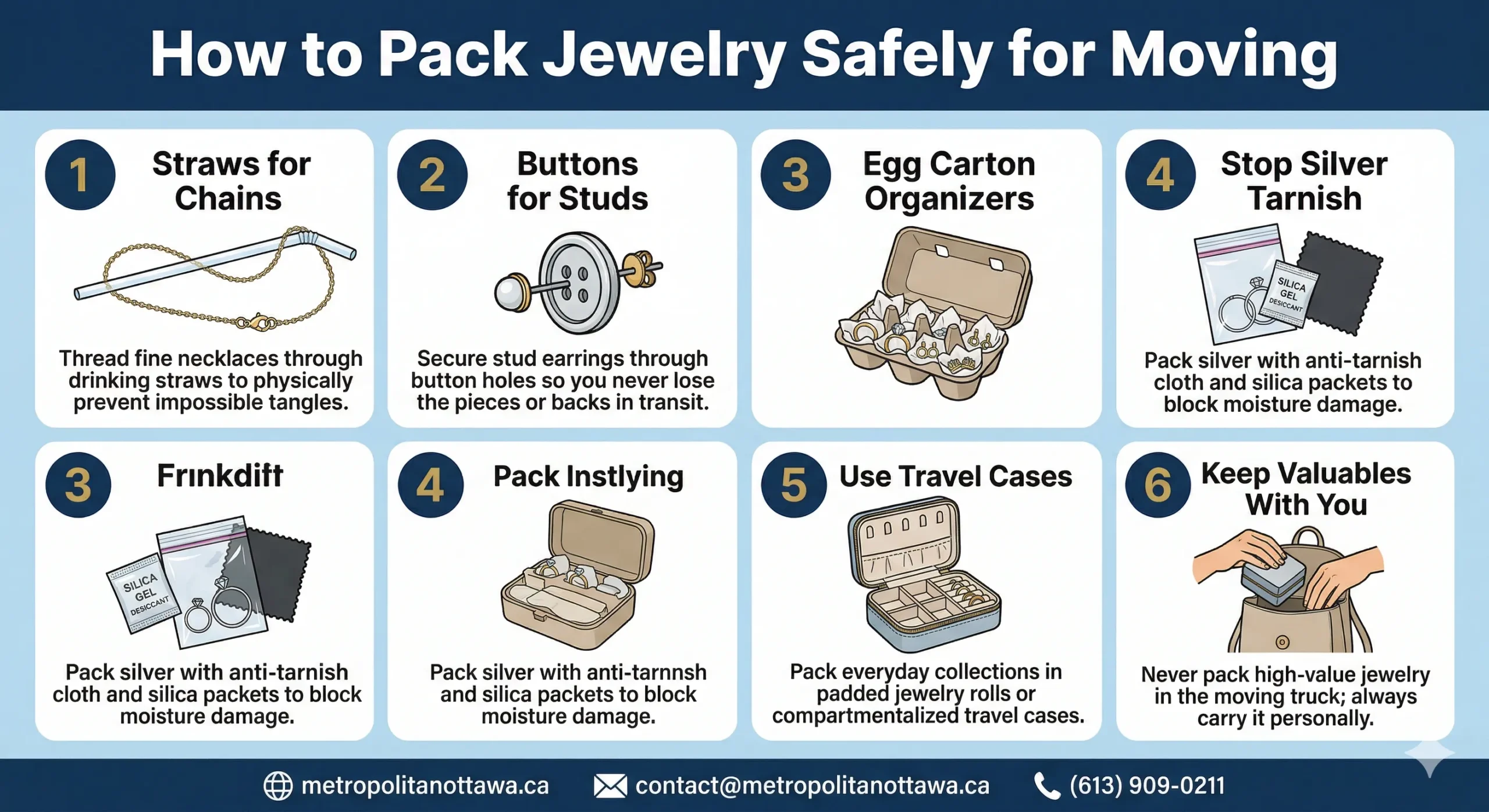
Plastic drinking straws — one of the most effective and least-known tools for preventing necklace and chain tangling during moves. Chains threaded through straws cannot tangle regardless of how the box moves during transit.
Buttons with multiple holes — used to secure stud earrings and prevent back separation during transit. Thread the post of each stud through a button hole and secure the back on the other side.
Egg cartons — one of the most practical and freely available containers for small jewelry pieces including earrings, rings, pendants, and charms. Each cup isolates one piece completely.
Padded jewelry rolls — fabric rolls with individual loops, pockets, and compartments that provide organized, cushioned storage for rings, bracelets, necklaces, and earrings simultaneously.
Travel jewelry organizer cases — rigid or semi-rigid cases with mirror, compartmented interior, and zipper closure that provide organized, impact-resistant storage during transit.
Original jewelry boxes — for pieces that came with purpose-built boxes, those containers are the best individual protection available.
Bubble wrap — for rigid jewelry items including cuff bracelets, statement pieces, and large pendants where impact protection is the primary concern.
<table border=”1″ cellpadding=”10″ cellspacing=”0″ style=”width:100%; border-collapse: collapse; background-color:#f9f9f9;”> <thead> <tr style=”background-color:#000080; color:#ffffff;”> <th>Material</th> <th>Best For</th> <th>Key Benefit</th> <th>Where to Source</th> </tr> </thead> <tbody> <tr> <td>Plastic drinking straws</td> <td>Necklaces and fine chains</td> <td>Physically prevents tangling during transit</td> <td>Any kitchen drawer or grocery store</td> </tr> <tr> <td>Buttons with holes</td> <td>Stud earrings</td> <td>Keeps post and back together without loss</td> <td>Sewing supply, craft stores, home</td> </tr> <tr> <td>Egg cartons</td> <td>Small earrings, rings, pendants</td> <td>Individual compartment isolation at zero cost</td> <td>Any kitchen — use what you have</td> </tr> <tr> <td>Anti-tarnish pouches</td> <td>Silver and silver-plated jewelry</td> <td>Prevents tarnish formation during transit</td> <td>Jewelry supply stores, online</td> </tr> <tr> <td>Padded jewelry rolls</td> <td>Multiple jewelry categories combined</td> <td>Organized, cushioned, compact storage</td> <td>Travel supply, department stores</td> </tr> <tr> <td>Travel jewelry organizer case</td> <td>Comprehensive everyday collection</td> <td>Impact resistance, organization, portability</td> <td>Travel supply, online retailers</td> </tr> <tr> <td>Small zip-lock bags</td> <td>Individual piece containment</td> <td>Prevents separation of small components</td> <td>Any grocery or dollar store</td> </tr> <tr> <td>Acid-free tissue paper</td> <td>Wrapping valuable pieces</td> <td>Prevents chemical interaction and scratching</td> <td>Moving supply stores, craft stores</td> </tr> </tbody> </table>
Threaded Drinking Straws for Chains: The Most Effective Necklace Tangling Prevention Available
The drinking straw method is one of those rare packing techniques that is simultaneously unknown to most movers and more effective than any purpose-built product at solving a specific problem. Anyone who has spent a frustrating hour trying to untangle a mass of fine chains packed together knows exactly how much value a simple straw provides.
How it works: Open the clasp of the necklace or chain. Thread one end of the chain into the drinking straw from one end and feed it through until the chain exits from the other end. The body of the chain now runs through the interior of the straw, while both ends with the clasp are accessible outside the straw. Fasten the clasp to secure the chain in a closed loop that cannot slip back out.
The chain inside the straw cannot tangle with itself because the straw walls keep the chain in a linear, contained path. Multiple straws containing multiple chains can be placed together in a zip-lock bag or small box without any chain-to-chain tangling, because each chain is physically isolated inside its own straw.
What works with the straw method:
- Fine gold and silver chains of any length
- Delicate pendant necklaces where the pendant can be removed and packed separately
- Layering chains that would otherwise create an immediate tangle when packed together
- Anklets and bracelet chains with similar fine construction
What requires a different approach:
- Very heavy statement necklaces whose weight causes straws to split — use a pool noodle segment cut to length for heavy chains
- Beaded necklaces — the beads cannot pass through a straw interior
- Chunky chain necklaces — too wide for standard straw diameter
- Braided and rope chains — the texture catches on straw interior walls
The pool noodle variation: For heavier chains that damage standard drinking straws, a foam pool noodle cut into 6–8 inch segments provides the same isolation principle at larger diameter. Coil the chain around the outside of the noodle segment and secure with a zip-lock bag around the entire piece.
Egg Cartons for Small Earrings: Free Compartmentalized Protection
Egg cartons are one of the most practically perfect free containers available for packing small jewelry pieces — and they are sitting in most kitchens entirely unused for their packing potential.
Each cup in a standard 12-egg carton provides individual isolation for one small jewelry piece. For a standard earring collection, each cup can hold one pair of studs, one pair of small hoops, or one pendant. The separation between cups prevents piece-to-piece contact entirely, and the relatively rigid cardboard structure provides better impact resistance than a fabric pouch packed with multiple pieces together.
The correct egg carton packing sequence: Place a small square of acid-free tissue paper in each cup before placing jewelry — this prevents any residual egg carton material or cardboard texture from contacting precious metal surfaces. Place one piece or one pair per cup. Close the carton and secure with a rubber band around the full carton. Place the secured carton in a zip-lock bag to prevent the carton from opening if the rubber band slips, then place in a padded box or jewelry case.
Beyond standard egg cartons: Specialty foam compartment inserts used by jewelry retailers are essentially a refined version of the egg carton principle — available from craft and jewelry supply stores, they provide the same individual compartment isolation with purpose-built materials and dimensions suited specifically to small jewelry pieces.
Organizing within egg cartons: Write a brief label on each cup’s outer rim before closing the carton — or keep a list that corresponds to cup positions — so that specific pieces can be located without opening every cup. For collections where specific earrings are frequently paired with specific necklaces, keep paired pieces in adjacent cups with a connecting note.
Buttons for Stud Earrings: Preventing the Most Common Small Jewelry Loss
Stud earrings represent one of the highest-risk categories for small component loss during moving — the earring back is small enough to fall free in any loosely packed container, and once it has separated in a moving box filled with packing paper, recovery is genuinely unlikely. The button method is the most effective and simplest solution available.
The correct button technique: Select buttons with at least two holes — standard four-hole shirt buttons work best. Thread the post of a stud earring through one hole in the button, then secure the earring back on the post on the other side of the button. Both the earring and its back are now mechanically secured to the same physical object and cannot separate regardless of how the container moves during transit.
Multiple stud pairs can be secured on a single button — thread each pair through a different hole pair or across adjacent holes until the button is fully utilized. Place the button with secured earrings in a small zip-lock bag before placing in the main jewelry container.
Alternative for small hoop earrings: Small hoop earrings can be closed and secured through a single button hole — the hoop diameter is small enough to fit through a button hole when the earring is closed, keeping both earrings of a pair together on the button without the back-separation risk that studs present.
Padded Jewelry Rolls: Organized Protection for Everyday Collections
Padded jewelry rolls are purpose-built travel and storage solutions that translate directly into excellent moving containers for everyday jewelry collections. A quality jewelry roll provides individual loops for rings and bracelets, padded compartments for earrings, and flat pockets for necklaces — all in a compact, rollable format that fits easily in a bag or small box.
What a padded jewelry roll protects:
- Rings stored in individual ring loops that maintain their shape and prevent stone-to-stone contact
- Bracelets in their own loops or compartments without pressure from adjacent pieces
- Earrings in individual zippered pouches or snap-close compartments
- Flat necklaces in dedicated flat pockets that keep them separated and untangled
Choosing the right roll for your collection: Padded jewelry rolls vary significantly in size, compartment configuration, and material quality. For moving purposes, choose a roll that accommodates your everyday jewelry volume with room to spare — overcrowding a roll defeats its organizational purpose and can create contact damage between pieces near the roll’s capacity limits. Rolls with a zippered outer closure provide better security during transit than those secured only with a tie.
Combining rolls with other techniques: A padded jewelry roll handles mid-range everyday jewelry most effectively. For fine chains and necklaces going into a roll rather than straws, clasp each necklace in its closed position and lay flat in the designated necklace pocket rather than loose. For pieces too valuable for a roll’s general storage, use the roll for everyday items and separate higher-value pieces into individual packaging before placing in a travel organizer case.
Travel Jewelry Organizer Cases: The Comprehensive Solution for Larger Collections
A travel jewelry organizer case — a rigid or semi-rigid case with a mirror, multiple compartmented sections, and a zipper or snap closure — provides the most complete single-container solution available for a comprehensive jewelry collection being moved.
The advantages of a travel organizer case over alternative containers:
The rigid or semi-rigid exterior of a quality organizer case provides impact resistance that fabric rolls and soft pouches cannot match. If a box shifts during transit and another box falls against it, a rigid case interior isolates the jewelry from the impact in a way that a soft container simply cannot.
The compartmentalization within a quality case provides individual isolation for multiple jewelry categories simultaneously — a ring roll, earring compartments, necklace hooks, and bracelet bar all within a single container that stays organized throughout transit.
The zipper or snap closure of a case prevents inadvertent opening during transit in a way that roll ties cannot fully guarantee. For long-distance moves to cities like Vancouver or Calgary where transit time extends to multiple days, a secured case closure matters more than it does for a short local move.
What to look for in a travel organizer case:
- Multiple compartment types — ring rolls, earring compartments, necklace hooks or loops, bracelet bar
- Zipper closure with a quality pull that will not fail under the friction of repeated transit handling
- Interior mirror — a practical feature that makes the case useful as an ongoing jewelry storage solution after the move
- Padded exterior — adds another layer of impact protection beyond the case structure itself
- Adequate size for your collection without excess space — a case that is too large allows pieces to shift within compartments
Category-by-Category Jewelry Packing Guide
<table border=”1″ cellpadding=”10″ cellspacing=”0″ style=”width:100%; border-collapse: collapse; background-color:#f9f9f9;”> <thead> <tr style=”background-color:#000080; color:#ffffff;”> <th>Jewelry Category</th> <th>Best Packing Method</th> <th>Container</th> <th>Special Consideration</th> </tr> </thead> <tbody> <tr> <td>Fine chains and necklaces</td> <td>Thread through drinking straws, clasp closed</td> <td>Zip-lock bag, then travel case</td> <td>One straw per chain — never combine two chains in one straw</td> </tr> <tr> <td>Statement necklaces</td> <td>Lay flat in acid-free tissue, close clasp</td> <td>Original box or flat jewelry tray</td> <td>Beaded necklaces — knot between each bead if possible</td> </tr> <tr> <td>Stud earrings</td> <td>Thread through button holes, secure back</td> <td>Zip-lock bag or egg carton cup</td> <td>Keep pairs on same button — one pair per button if possible</td> </tr> <tr> <td>Hoop and drop earrings</td> <td>Individual zip-lock bags or egg carton cups</td> <td>Egg carton or earring compartment in case</td> <td>Close hoop clasps before bagging to prevent snagging</td> </tr> <tr> <td>Rings</td> <td>Individual zip-lock bags or ring roll loops</td> <td>Padded roll or travel organizer case</td> <td>Stone-to-stone contact scratches — isolate gemstone rings individually</td> </tr> <tr> <td>Bracelets — delicate chain</td> <td>Straw method or individual zip-lock bag</td> <td>Travel case bracelet bar or padded roll</td> <td>Clasp all bracelets closed before packing</td> </tr> <tr> <td>Cuff and bangle bracelets</td> <td>Wrap in acid-free tissue, then packing paper</td> <td>Original box or small padded box</td> <td>Bangles stacked together scratch — wrap each individually</td> </tr> <tr> <td>Watches</td> <td>Original box preferred; wrap in soft cloth if unavailable</td> <td>Original box or padded pouch</td> <td>Wind crown in and lock before packing — transport face-up</td> </tr> <tr> <td>Pearls</td> <td>Wrap individually in soft, clean chamois</td> <td>Individual pouch, separate from all other jewelry</td> <td>Pearls scratch at hardness 2.5 — most materials scratch them</td> </tr> <tr> <td>High-value fine jewelry</td> <td>Original box with documentation</td> <td>Personal bag — travel with you, not in moving truck</td> <td>Photograph before packing, carry personally throughout move</td> </tr> </tbody> </table>
Protecting Specific Gemstone and Material Types
Different gemstones and jewelry materials have different hardness levels and therefore different vulnerability profiles when packed together. Understanding which materials scratch which prevents irreversible damage during transit.
Diamond: The hardest natural material — scratches everything else but is virtually scratch-proof by other jewelry materials. The risk with diamonds is not that they will be scratched, but that they will scratch other pieces. Always pack diamond jewelry separately from softer gemstones and metal surfaces.
Pearls: Among the softest and most vulnerable jewelry materials with a hardness of approximately 2.5 on the Mohs scale. Pearls are scratched by virtually every other gemstone and most metals. They should be packed in their own soft chamois cloth pouch, entirely separated from all other jewelry, and never allowed to contact any hard surface or other piece.
Emeralds and opals: Both are relatively soft and internally fractured or layered in ways that make them vulnerable to impact and temperature shock. Pack in individual padded pouches, wrapped in acid-free tissue, and consider carrying personally for long-distance moves where transit time and handling are more extensive.
Gold and platinum: Both metals are relatively resistant to tarnish but can develop surface scratches when packed with other metal pieces. Individual zip-lock bags prevent metal-to-metal contact effectively.
Silver: Tarnishes readily when exposed to humidity and sulfur compounds in air. Pack silver jewelry in anti-tarnish pouches or wrap in anti-tarnish cloth before sealing in zip-lock bags. A silica gel packet in the container absorbs moisture during transit.
Costume and fashion jewelry: The plating on costume jewelry pieces is the thinnest and most vulnerable surface finish in any jewelry collection. Pack individual pieces in zip-lock bags and keep well away from genuine precious metal pieces — the friction of costume jewelry against genuine silver or gold can transfer plating residue and create permanent surface marks on the fine jewelry.
Keeping High-Value Items with You: The Non-Negotiable Rule
The most important safety principle for moving high-value jewelry is the one that no packing technique can replicate: keep your most valuable pieces with you personally throughout the entire move rather than placing them in the moving truck.
Why this rule is absolute: Moving trucks are not security vaults. They are transported vehicles that stop at rest areas, require overnight parking during long-distance moves, and pass through areas where vehicle break-ins occur. The contents of a moving truck are generally covered under the moving company’s standard liability at released value — typically $0.60 per pound. A diamond ring weighing a fraction of an ounce receives essentially zero coverage under released value protection regardless of its actual worth.
Beyond theft risk, moving trucks experience temperature variation, vibration, and handling conditions that are perfectly acceptable for furniture and boxes but represent unnecessary exposure for irreplaceable fine jewelry.
What qualifies as high-value for personal carry:
- Diamond, ruby, sapphire, and emerald jewelry of any significant carat weight
- Fine jewelry of strong sentimental value — engagement rings, wedding bands, inherited pieces, anniversary gifts
- Watches with significant monetary value
- Antique and estate jewelry where condition affects collectible value
- Any piece whose loss or damage would cause genuine, lasting distress regardless of monetary value
How to transport high-value jewelry personally: Use a small, hard-sided jewelry case or a quality padded pouch carried in your personal bag — not the moving truck, not checked luggage in air travel, not an unlocked car glovebox. The piece stays within your physical control from the moment it leaves its permanent home to the moment it arrives at the new one.
For households making a long-distance inter-provincial move where there is any gap between your departure and the truck’s arrival, the personal carry rule becomes even more critical — high-value jewelry should never spend a night unsecured in a parked moving truck.
Valuables Insurance for Moving: What Jewelry Owners Must Understand Before Moving Day
Moving insurance is the most misunderstood component of the relocation process for households with significant jewelry collections — and the gap between what standard moving coverage provides and what jewelry collections are actually worth is one of the most consequential financial surprises that unprepared movers discover after the fact.
Standard released value protection: The default coverage offered by most moving companies is released value protection based on weight — typically $0.60 per pound of item weight. A pair of diamond earrings weighing 5 grams would receive approximately $0.003 in coverage under this standard. This coverage level is entirely inadequate for any jewelry of value.
Full value protection: Moving companies are required to offer full value protection as an upgrade — coverage that provides repair, replacement, or cash settlement at current market value for damaged or lost items. For households with significant jewelry collections, full value protection is the minimum appropriate coverage level. Confirm the specific terms of full value protection with your moving company before signing any moving contract, as exclusions and per-item limits vary between providers.
Third-party jewelry insurance: For collections of significant total value, third-party specialty insurance provides the most comprehensive coverage. Specialist jewelry insurers offer policies that cover pieces during transit, provide agreed-value rather than market-value settlements, and often extend coverage to loss and mysterious disappearance — categories that standard moving insurance does not address.
Documentation requirements for all coverage: Before packing any valuable jewelry, photograph each piece against a clean background from multiple angles. For pieces with appraisal documentation, retain copies alongside the photographs. For pieces without formal appraisals, consider obtaining appraisals before the move for any piece whose value exceeds what you would absorb without insurance compensation.
The moving cost guide for Canada provides broader context on insurance options and valuation considerations for high-value household belongings during a relocation.
Anti-Tarnish and Moisture Protection During Transit
Silver tarnish and moisture damage are slow-moving threats that do not produce immediate visible results but create significant cleaning and restoration requirements that a few simple precautions during packing would have entirely prevented.
Anti-tarnish measures:
- Wrap silver pieces in anti-tarnish cloth before placing in zip-lock bags — the cloth’s silver-absorbing compounds prevent tarnish formation during transit
- Include a silica gel desiccant packet in each jewelry container — these inexpensive packets absorb moisture from the container environment and prevent the humidity that accelerates tarnish on silver and causes corrosion on plated pieces
- Use anti-tarnish zip-lock bags for silver storage — these specialty bags are lined with anti-tarnish compounds that provide protection for months without requiring wrapped cloth
Moisture protection for all jewelry categories:
- Ensure all pieces are clean and completely dry before packing — residual perfume, body oil, and moisture on metal surfaces accelerate tarnish and can create corrosion over extended transit periods
- Never pack jewelry in airtight containers without a desiccant packet — airtight containers trap residual moisture with the contents
- For long-distance moves to cities like Edmonton or Saskatoon where transit extends over multiple days, double the desiccant packet quantity in each jewelry container
Organizing Jewelry Before Packing: The Inventory Step That Most Movers Skip
A move is one of the most common occasions for jewelry to go missing without any clear explanation — not through theft or damage, but through disorganization that makes pieces impossible to locate in the post-move unpacking process. A brief inventory before packing begins eliminates this entirely preventable loss category.
Creating a jewelry inventory: Before packing any piece, photograph every item in your collection. Organize the photographs by category — necklaces, earrings, rings, bracelets, watches, other — and store the images in a cloud location that is accessible from your phone throughout the move. This inventory serves three functions simultaneously: it documents condition for insurance purposes, provides a reference list for confirming everything arrived, and creates a searchable record if a specific piece cannot immediately be located during unpacking.
Labeling containers with enough specificity: Label each jewelry container — whether a travel case, padded roll, or zip-lock bag collection — with sufficient detail to locate specific pieces without opening everything. A container labeled simply JEWELRY tells you nothing useful when you need your everyday earrings at 7 AM in a new home still full of unpacked boxes. A container labeled EVERYDAY EARRINGS AND RINGS — UNPACK FIRST tells you exactly where to look and how urgently to prioritize that container.
Coordinating jewelry inventory with the broader packing process: The how to pack for moving guide provides the broader household inventory framework that jewelry documentation fits within — a systematic approach to tracking belongings across the entire relocation rather than managing jewelry as an isolated category.
Common Jewelry Packing Mistakes and How to Avoid Every One
<table border=”1″ cellpadding=”10″ cellspacing=”0″ style=”width:100%; border-collapse: collapse; background-color:#f9f9f9;”> <thead> <tr style=”background-color:#000080; color:#ffffff;”> <th>Common Mistake</th> <th>Why It Causes Damage or Loss</th> <th>The Correct Approach</th> </tr> </thead> <tbody> <tr> <td>Packing all necklaces loose together</td> <td>Creates impossible tangles during transit vibration</td> <td>Thread each chain through an individual drinking straw</td> </tr> <tr> <td>Packing stud earrings loose in a pouch</td> <td>Backs separate and are lost in packing material</td> <td>Thread posts through button holes and secure backs</td> </tr> <tr> <td>Packing all jewelry together in one bag</td> <td>Gemstone-to-gemstone contact causes scratching</td> <td>Individual containment for every piece</td> </tr> <tr> <td>Using newspaper or printed paper for wrapping</td> <td>Ink transfers to metal surfaces and gemstone settings</td> <td>Use acid-free tissue paper exclusively for jewelry</td> </tr> <tr> <td>Placing high-value jewelry in the moving truck</td> <td>Exposes irreplaceable pieces to theft, damage, and inadequate coverage</td> <td>Carry all high-value jewelry personally throughout the move</td> </tr> <tr> <td>Packing silver without anti-tarnish protection</td> <td>Humidity during transit causes rapid tarnish formation</td> <td>Wrap in anti-tarnish cloth and include silica desiccant packets</td> </tr> <tr> <td>Packing pearls with other jewelry</td> <td>Pearls are scratched by virtually all other materials</td> <td>Pack pearls alone in soft chamois, completely separated</td> </tr> <tr> <td>No jewelry inventory before packing</td> <td>Missing pieces impossible to identify without pre-move reference</td> <td>Photograph every piece before packing begins</td> </tr> <tr> <td>Relying on standard released value insurance</td> <td>Provides $0.60 per pound — essentially zero coverage for jewelry</td> <td>Arrange full value protection or specialist jewelry insurance</td> </tr> <tr> <td>Packing jewelry with residual perfume or moisture</td> <td>Accelerates tarnish and corrosion on metal surfaces</td> <td>Clean and dry all pieces completely before packing</td> </tr> </tbody> </table>
Packing Jewelry for Long-Distance Moves: Enhanced Precautions for Extended Transit
Packing jewelry for a local move within Ottawa, Kanata, or Gatineau involves minimal transit time and relatively controlled handling conditions. A long-distance move to Halifax, Winnipeg, or Victoria introduces multi-day transit with temperature variation, extended vibration, and multiple handling transitions that require enhanced precautions.
The personal carry rule becomes absolute for long-distance moves — no high-value jewelry should spend a night in a parked moving truck regardless of lock quality or alarm systems.
Double desiccant protection — include two silica gel packets in each jewelry container rather than one. Extended transit through varying climate zones can expose containers to humidity levels that single packets cannot fully address.
Vacuum-seal zip-lock bags for silver — for long-distance moves, pressing as much air as possible out of zip-lock bags containing silver pieces before sealing provides additional protection beyond standard sealing alone.
Consider specialist jewelry transport — for collections of exceptional value, specialist fine art and valuables transport companies provide climate-controlled, insured, and tracked transit that standard moving trucks cannot match. For households whose jewelry collection represents significant monetary value, the cost of specialist transport is modest relative to the protection it provides.
The long-distance moving guide covers the full preparation framework for moves where extended transit requires enhanced protection across all fragile and valuable household categories.
Unpacking and Resettling Jewelry at the New Home
Jewelry unpacking requires the same deliberate approach as packing — opening containers randomly and placing pieces wherever convenient creates the disorganization that makes specific pieces impossible to find in a new space. The how to unpack after moving guide covers the full sequencing framework, but jewelry-specific priorities include:
Inspect every piece immediately upon arrival: Open every jewelry container and compare contents against the pre-move photographic inventory. Identify any missing or damaged pieces immediately upon arrival rather than days later — insurance claims and moving company liability notifications both have time limits that require prompt action.
Allow silver to acclimatize before storing: Silver jewelry exposed to varying humidity during transit may show minor tarnish even with anti-tarnish protection. Allow pieces to acclimatize to the new home’s humidity level for 24–48 hours before cleaning and storing in permanent jewelry boxes or organizers.
Establish permanent storage before unpacking: Set up the jewelry box, organizer, or storage system in its permanent location before unpacking jewelry into it. Placing pieces into temporary locations during unpacking creates the disorganization that leads to misplaced items in the first weeks in a new home.
For guidance on the full post-move settling process — including establishing routines in a new space efficiently — the settling after moving guide and first week after moving to Ottawa guides provide the most complete resources available.
Frequently Asked Questions
What is the safest way to pack jewelry for moving?
The safest way to pack jewelry for moving combines individual piece containment, category-appropriate methods — drinking straws for chains, buttons for studs, egg cartons for small pieces — anti-tarnish protection for silver, and personal carry for all high-value pieces. Never place valuable jewelry in a moving truck. Photograph every piece before packing for insurance documentation.
How do I prevent necklaces from tangling during a move?
Thread each necklace and chain individually through a plastic drinking straw and clasp it closed at the straw exit. The straw physically prevents tangling regardless of how the container moves during transit. One straw per chain — never thread two chains through the same straw. For heavy chains, use a foam pool noodle segment as an alternative.
Should I keep jewelry in the moving truck or carry it myself?
High-value jewelry — fine pieces, diamonds, heirlooms, watches, and anything of significant sentimental value — should always be carried personally throughout a move, never placed in the moving truck. Moving trucks are subject to theft, temperature variation, and standard liability coverage that is wholly inadequate for jewelry values. Carry valuable pieces in a personal bag that remains under your direct control.
What insurance do I need for jewelry during a move?
Standard released value protection offered by most moving companies covers jewelry at $0.60 per pound — essentially zero coverage for any piece of value. At minimum, arrange full value protection through your moving company. For collections of significant total value, specialist jewelry transit insurance from a third-party insurer provides the most comprehensive protection including coverage for loss and mysterious disappearance.
Does Metropolitan Movers Ottawa provide professional packing services for jewelry and valuables?
Yes. Metropolitan Movers Ottawa provides comprehensive packing and unpacking services for entire households including guidance on jewelry and high-value item handling. The team brings over 15 years of experience coordinating the safe relocation of valuable personal property, and advises clients on personal carry protocols, insurance options, and documentation requirements for high-value collections before every move.
Every Piece You Pack Tells a Story
The safest way to pack jewelry for moving is the approach that treats each piece — regardless of monetary value — with the individual attention it deserves. Drinking straws that prevent tangle damage. Buttons that keep stud backs from disappearing. Egg cartons that isolate small pieces at zero cost. Anti-tarnish cloth that protects silver through temperature and humidity variation. Personal carry that keeps irreplaceable pieces under your direct control throughout the entire move. A pre-move photographic inventory that ensures nothing is lost without documentation. And an insurance arrangement that provides genuine coverage rather than the $0.60-per-pound fiction that standard protection offers. When every technique in this guide is applied consistently, your jewelry collection arrives at your new home exactly as it left your old one — every chain untangled, every stone unscratched, every piece accounted for. Metropolitan Movers Ottawa brings 15+ years of experience to every relocation — from local moves within Ottawa and Nepean to long-distance moves across Canada. Whether you need professional packing support, a complete residential move, or guidance on protecting your most valuable belongings, reach out today and move every piece with complete confidence.